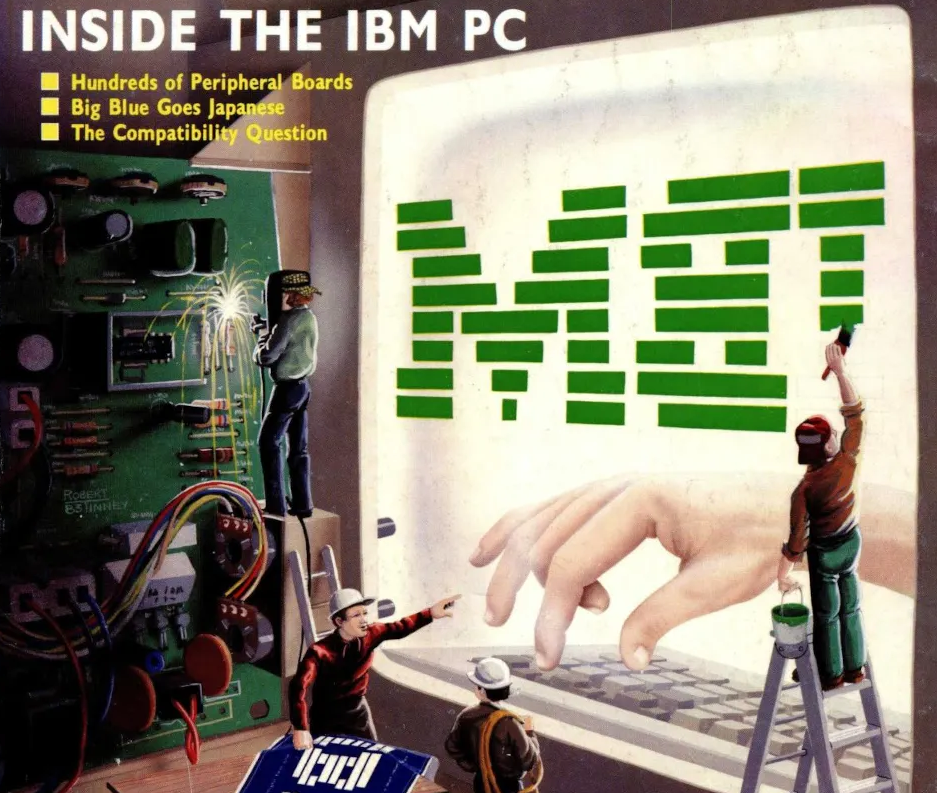
The arrival of the IBM PC was the most significant event in the history of the personal computer since the arrival of the Altair. A slow-rolling wave, it gradually washed across the marketplace, starting with the business market, where the IBM name had the greatest attraction. Some companies rode atop the wave, carried to new heights on its back: Tecmar, a supplier of scientific computer plug-in cards, grew to 400 employees and $100 million in revenue because of founder Martin Alpert’s early bet on the IBM PC. Many were pushed along by it, driven into new channels by a force they could not resist: Eagle Computer, an established Silcon Valley computer maker, saw the writing on the wall and became one the first to produce a fully-IBM-compatible computer, the Eagle PC. Others, as we shall see, were simply crushed beneath it.[1]
To follow this wave to its final petering out, well into the 90s, would take us far beyond the scope of this particular story. Here we will examine only how it rolled across the world of personal computing in its first few years, up to about 1983—we will also deliberately skirt the topic of the IBM clones, whose story also belongs to a subsequent volume.
The Also-Rans
IBM wasn’t the only established computer firm that tried to move down-market from large, expensive machines intended for sharing within an organization to microcomputers aimed at individuals. Hewlett-Packard, Digital, Wang, and Xerox all released personal computers of their own in the early 1980s. Why did none of them achieve anything approaching the success of the IBM PC? Each would-be rival had its own particular weaknesses: too expensive, niche, too late. The market was waiting for a standard, and IBM’s brand recognition and expansive marketing campaign gave their computer the most convincing case to be just that.[2]
The most interesting failure from the point of view of our story is that of Digital Equipment Corp (DEC, or simply Digital). To the hobbyists who bought Altair and its successors, IBM was the stodgy, conservative enterprise that would never “get it,” while Digital was the embodiment of interactive computing, the inspiration for many early microcomputer designs and indeed the template for much of hobby computer culture. Why then, did it stumble so badly in a match-up where it ought to have had home-field advantage?
In short, Digital’s approach to the personal computer market was both incoherent and out-of-touch, thanks in large part to the strategic misprision of Ken Olsen. Olsen, CEO of Digital since its founding in 1957, didn’t believe in the personal computer as a product, didn’t believe in mass marketing of computers as a sales strategy, and didn’t believe in the power of software to drive hardware sales.
Engineering leaders at DEC started trying to sell Olsen on personal computer concepts years before IBM launched Project Chess. In 1974, Dave Ahl pitched a personal, all-in-one version of the PDP-8 minicomputer, but was shot down by Olsen. Olsen’s attitude at the time remained his attitude throughout the 1970s, in growing defiance of the facts: “The world is going time-sharing,” he said, “[i]t’s not going small, stand-alone computers.” Andy Knowles, who designed the DEC Personal Data Terminal (PDT), was careful not to put the word “computer” in its name to avoid Olsen’s veto, but nonetheless still got very little support for the product.[3]
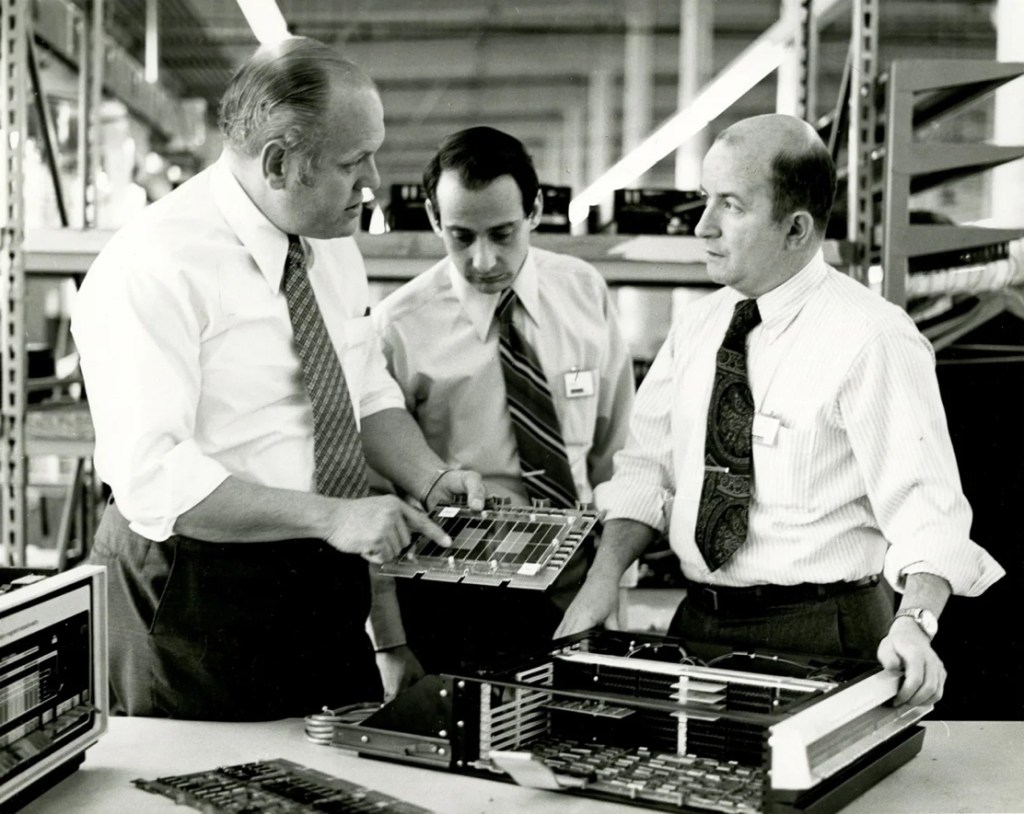
Then, in 1980, Olsen had a sudden change of heart. Why? He would say only that he was persuaded by critics outside Digital and executives within it. Gordon Bell, DEC’s chief of engineering, alleged that Olsen was goaded into entering the personal computer race by a young woman reporter at Business Week, whose probing questions about DEC’s low-end strategy “challenged his manhood.” Whatever the reason, he suddenly began giving pep talks about “computers for clerks and clerics,” as DEC wags put it.[4]
Bell, who obviously had a strained relationship with his former boss, later placed all the blame for what followed on Olsen: “There was a lot of entrepreneurialism, or perhaps it might better be called court politics. Everyone focused on trying to please Ken. What do I think about that? Ken was the sole manager, or king, of the PC’s. I want to lay the PC disaster totally at his feet.” But Bell himself must take some blame for failing to exert his influence to shape a coherent PC strategy; he gave all his attention to DEC’s next generation VAX time-sharing systems.[5]
An executive working group headed by Olsen put engineer Avram Miller in charge of the “Project CT” (for Communicating Terminal) in August 1980, with a $20 million budget and a nine-month schedule. This was almost exactly in line with the timeline of IBM’s still-secret Project Chess, but unlike IBM, Digital’s delivery would slip far behind its initial plans. One major difference: in order to maintain the company’s high quality standards, executives insisted on building virtually everything in the computer in-house: DEC “tooled the sheet metal and plastic for all the components, manufactured the floppy disks, developed the microprocessor.” This choice alone made the nine-month timeline impossible; it would be closer to three years before the Project CT computer became widely available.[6]
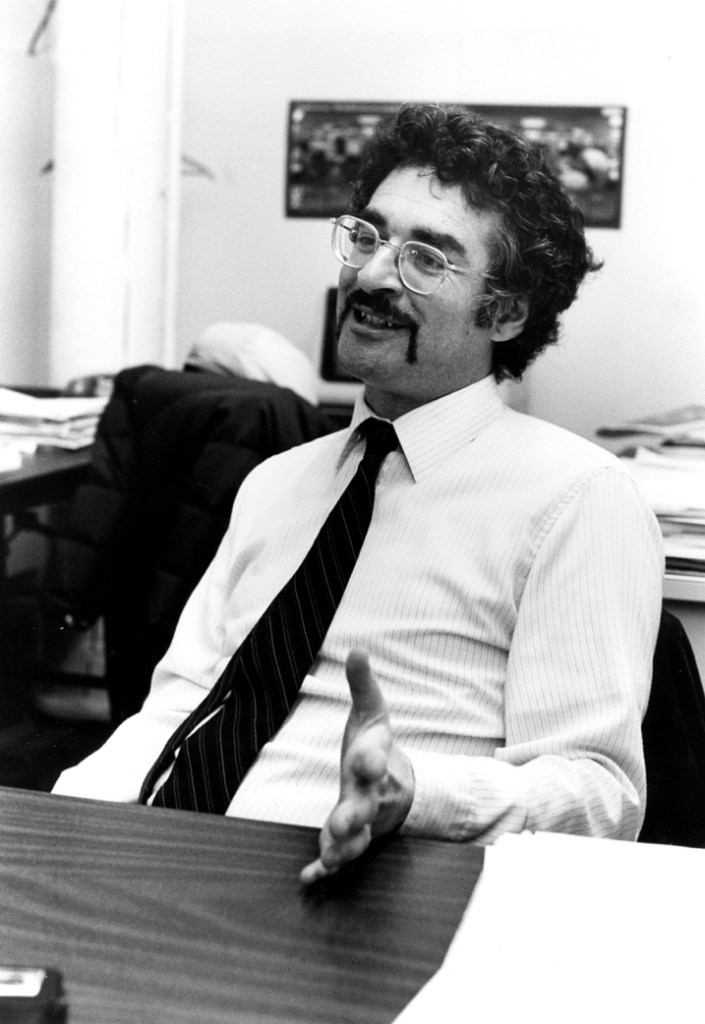
Then, Miller found himself with competition: two other DEC personal computer projects. The first came from the word processing group. Olsen’s brother Stan had championed the DECMate, an all-in-one word processor intended to compete with dedicated authoring systems like those of Wang Laboratories. It didn’t do well, and Stan Olsen soon showed himself the door, but that didn’t stop the product division from having another go with a more flexible product, the DECMate II, which could act as a word processor or a general-purpose computer running CP/M.[7]
Olsen himself instigated the second competitor: unhappy that Miller was neglecting plans for a lower-end variation of the CT, and wanting an alternative that directly answered the newly-announced IBM PC, he kicked off a whole new personal computer project in 1981, under Barry Folsom, which became the DEC Rainbow. “Barry’s proposal,” Miller later wrote, “was ingenious. He would use the packaging, keyboard, monitor, and other peripherals that we had developed for the Professional, but the motherboard would be different.” Onboard that motherboard were two CPUs: Z80 and 8088, to support CP/M and MS-DOS. This was a clever hedge against the possible victory of either operating system, but it pushed the cost of the computer upward and neither wager would pay out.[8]
The effects of this internal competition were corrosive, inside Digital and out: Miller’s machine could not get word-processing software, because the team that might write it had committed all its resource the DECMate II. Folsom and Miller were both telling confused third-party software vendors to bet on their horse. The former believed that the latter had undercut him with Visicorp (maker of top spreadsheet VisiCalc), telling them “that the Rainbow was an underfunded, unapproved machine that would likely not see the light of day.” Even if this were a false rumor, that Folsom could believe shows how ugly things had gotten.[9]
The three projects were finally ready for a joint announcement in May 1982, nine months after the launch of the IBM PC, and a further year would pass before DEC could produce any of the computers in large numbers. They were accompanied by no clever marketing campaign, and no blockbuster business application: “software,” Olsen expected, in a terrible misreading of the personal computer market, “would follow good hardware.” DEC had shown up late with a confusing line-up of products that lacked the key word processing and spreadsheet software that people wanted and cost more than the IBM PC, which was already well on its way to becoming the de facto market standard. The only way out was to join the herd and conform to the IBM standard, which Olsen would never do.[10]
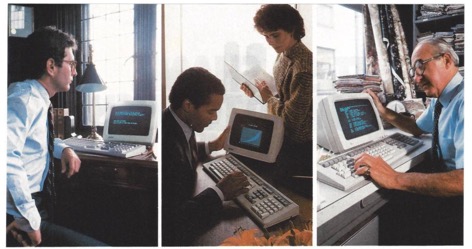
Miller’s DEC Professional line, expected to be the company’s flagship personal computer (the others, in Olsen’s mind, were “back-ups”), instead it proved the runt of an unprepossessing litter. Far more expensive and full-featured than the IBM PC, it had typical features of what was later called a “workstation,” with a bitmapped graphical display, an operating system compatible with DEC’s PDP-11 line of minicomputers, support for a variety of networking standards for communicating with and a starting price of $4,000. It was in many ways a beautiful product (and perhaps the first PC designed to stand in a “tower” configuration), but it sold only 13,000 units in 1983. Miller knew his product was doomed well before that, and jumped ship for Franklin Computer, a maker of Apple clones.[11]
The Rainbow, the least expensive option at $3500 and with support for at least some existing CP/M and MS-DOS software, was the closest of DEC’s offerings to what buyers wanted and sold 23,000 units that year. But, lacking full hardware compatibility with the IBM, it could not run most existing PC software. In the end, DEC saw effectively no return from the $900M it had sunk into the three PC programs.[12]
DEC’s strategic blunders help to illuminate the causes for the PC’s success; clearly it was more than the unearned legacy of the IBM brand that differentiated Project Chess from Project CT: the former delivered a less expensive machine on a shorter timeline with a coherent product lineup and a powerful mass-marketing push. Most importantly, IBM leadership, unlike Olsen, was willing to throw out their existing culture of planning, procurement, and sales to adapt to the microcomputer market.
Olsen responded to the first major reversal in DEC’s history by reverting to his natural attitude of contempt toward the personal computer. In November 1984 he told the Boston Globe they were “cheap, short-lived and not very accurate machines.” When he recorded an interview for the National Museum of American History in 1988, he chose to pretend that his episode of enthusiasm had never happened:
We concentrated on the making of networks of small computers and large computers which is a much more challenging job and devoured all the resources we had. The PC itself was a component to the network. We made some PC’s designed to be part of the networking but the general PC market was not for us. There were too many people in it and it turned out to be true. At one time I think there was 500 or 700 people making PC’s. Anybody could build them. You could build them in your basement. That was not for us.[13]
Heteroousian
Digital tried to leverage its expertise in high-performance computer systems to take over a market with very different characteristics; they (unlike IBM) failed in large part because they lost sight of those differences. What of the companies already established as the major players in personal computing? The 1977 Trinity—the Apple II, Commodore PET, and Tandy/Radio Shack TRS-80—had sold in the hundreds of thousands and expanded the audience for microcomputers beyond the hardcore hobbyists. All three companies were still powerful forces in the personal computer market in 1981, and all survived the IBM wave for a time, but none were sufficiently prepared to repulse it.
Commodore, having recently shifted its focus to inexpensive home computers with the VIC-20 and the soon-to-be-released Commodore 64, had the luxury to completely ignore the IBM PC for quite some time. One could theoretically buy a minimally configured PC for about $1600, but this was just a marketing come-on. A realistic configuration (with forty-eight kilobytes of memory and a disk drive) cost over $2500. This presented no threat to the sales of the $300 VIC-20 home computer (which appealed to video-gaming loving children and the wishful thinking of their parents) and vice versa. Commodore, for the time being, hid safely in the underbrush while this fearsome new predator lumbered by.[14]
Tandy also had its own home computer line, the Color Computer, but it had turned its primary computer business in exactly the opposite direction, leaning into the TRS-80’s popularity with small businesses with the upscale Model II and trying to shed its reputation as a bargain brand. This put it directly in the oncoming path of IBM.
Rather than simply be flattened, in 1983 they tried to ride the wave by releasing the Tandy 2000, which would run MS-DOS (like the IBM PC) but boasted a more powerful 80186 processor. But, like the Rainbow, it was not fully compatible with programs written for the IBM. Steve Leininger, designer of the TRS-80, warned his managers that it wouldn’t work: “Tandy was under the assumption that there were going to be three standards for microcomputers: Apple, IBM, and Tandy… I don’t know what they were thinking. The sun gets awfully hot out here. Maybe it baked their brains.”[15]
As Ken Olsen had learned (or perhaps failed to learn), superior hardware would not sell personal computers that didn’t run the user’s preferred software. Tandy caved to full IBM compatibility the following year with the deflated Tandy 1000. This new IBM-compatible line, propped up by the still numerous but increasingly démodé network of Radio Shack stores, worked well enough to keep a Tandy computer brand operating into the 1990s.[16]
Meanwhile, the once-mighty TRS-80 brand ended with the Model 4 (released in 1983), leaving its fans with regretful might-have-beens. Priming the Pump, a history of and love letter to the TRS-80,documents the sad twilight years: magazines and catalogs shrinking and decaying from glossy color to cheap newsprint while increasingly desperate software publishers attempted to paint over the holes of their sinking ship with specious optimism.[17]
Though the sun in Silicon Vally was far milder than in Texas, Apple was if anything more certain than Tandy of their ability to weather the IBM storm. They responded to the PC’s arrival with an act of bold hubris, a full-page ad in the August 24, 1981 Wall Street Journal with the tagline “Welcome, IBM. Seriously.” This brazen attempt to position Apple as the Coke to IBM’s Pepsi (and dismiss other competitors as trifling RC Colas) was born out of confidence, not desperation.[18]
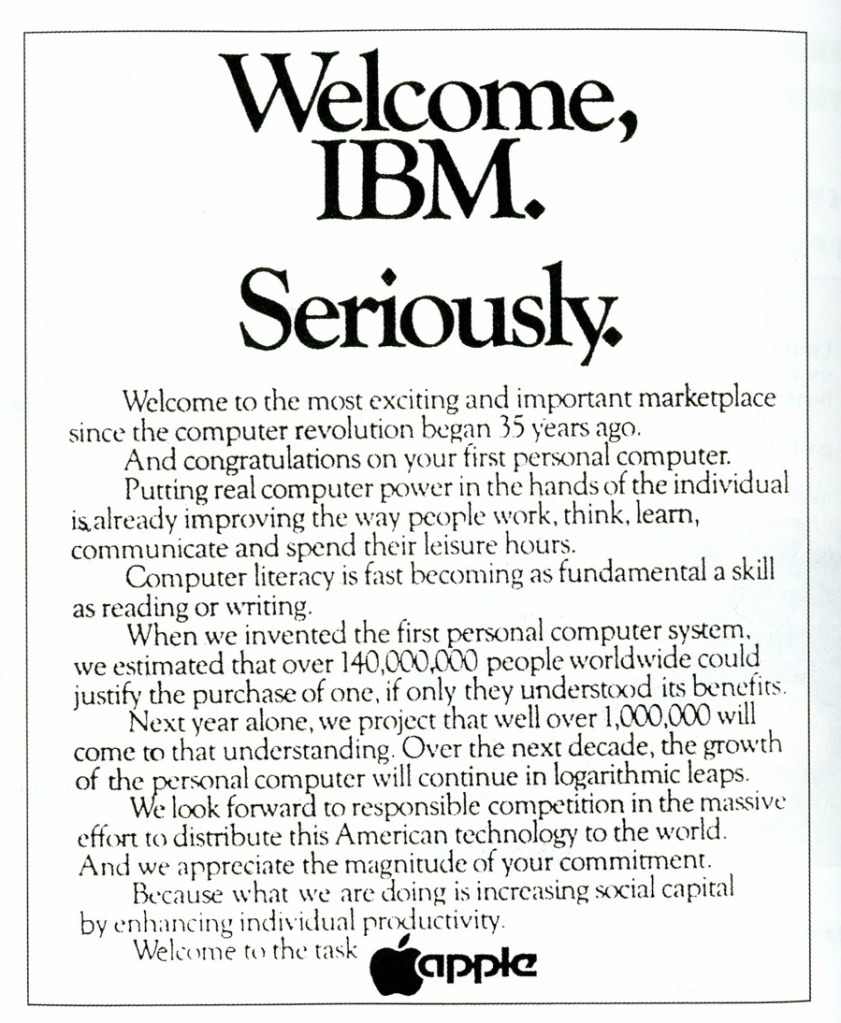
Apple’s engineering team considered the IBM PC “half-assed,” nothing to be impressed with compared to what they were building, but like many other engineers before and since, they put too much store in hardware niggles. They should have taken heed of the fact that VisiCalc, the software package that had made Apple a huge success among businessmen, was available for the IBM PC at its debut, and that the business world was hungry for a next-generation platform that they could rely on to be well-supported and useful well in the 1980s, something which neither the dated Apple II nor the compromised Apple III could offer.[19]
Apple leadership took IBM’s capabilities seriously enough to attempt to woo Don Estridge to become their new CEO in 1982, but he would never be lured away from Florida, even with far more money and influence than he could hope to enjoy at IBM on offer. Jobs and Markkula instead opted for John Sculley, a Pepsi executive, on the theory that Apple’s future success hinged on skill at selling products to consumers, not on the petty details of which chips and software they produced. This may have been taking the lesson of excessive attention to technical particulars a bit too far.
The Sculley hire would have mixed results, but it was Apple’s already established product strategy—the failure of the Apple III in 1980-1981 combined with Apple’s lack of any 16-bit successor—that left businesses looking for an alternative. In 1983, Apple released the 16-bit Lisa, but like the DEC Professional, it was a proto-workstation, an over-featured and overpriced machine with few prospective buyers (in fact, at base price of $10,000, it made the DEC Professional look like a positive bargain). The door was open for IBM to establish itself as the business standard.[20]
By 1983, IBM had surpassed Apple in market share of higher-end computers (those selling for over $1000), by an estimated twenty-six to twenty-one percent. The arrival of a next-generation spreadsheet program in 1983, exclusive to the IBM PC, put Apple even more on its heels. Mitch Kapor, an employee at VisiCalc publisher Personal Software, grew restless in 1981 and decided to start his own software business; when he saw the announcement of the IBM PC, he knew that would be his target platform. With programmer Jonathan Sachs and the backing of venture capital he created Lotus 1-2-3, which combined a spreadsheet with a rudimentary database, graphical charts for visualizing data, and the capability to hold much more data in memory, because of the all of the larger RAM banks that the IBM PC could support.[21]
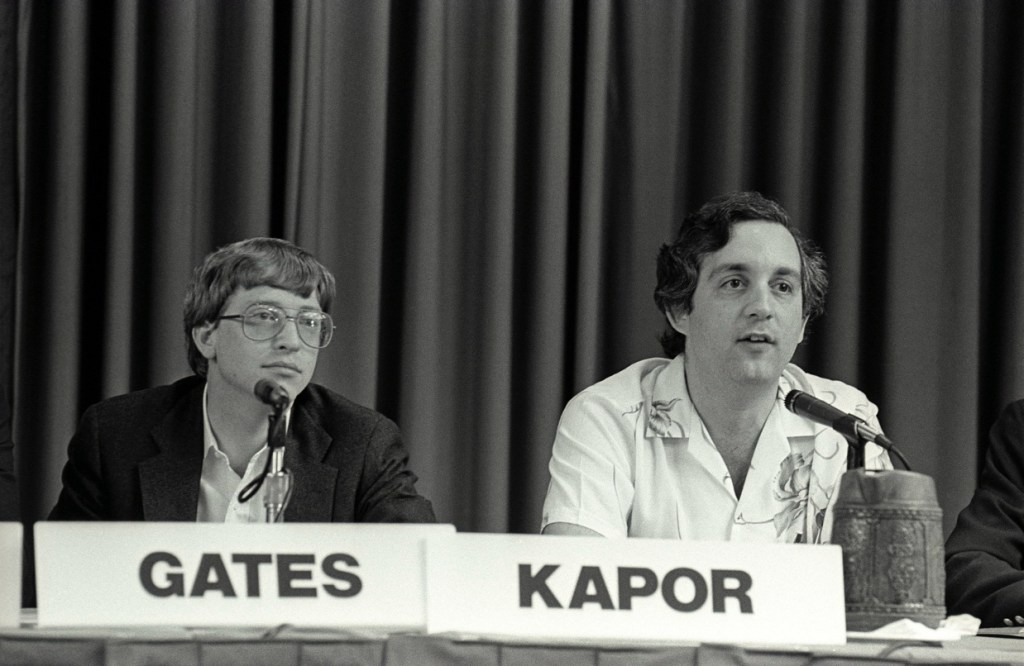
1-2-3 was an instant hit and began selling PCs the way that VisiCalc used to sell Apples. It is worth reflecting at this point just how much the personal computer business had expanded through the process of continuous exponentiation. Just seven years before, in 1976, personal computer software barely existed as a business: Microsoft pulled in all of $23,000 in revenue that year. Four years later, Personal Software made $3.7 million from VisiCalc. By the end of 1983, Lotus had $53 million in sales, putting it third in software revenue, just behind Microsoft and MicroPro (creator of WordStar).[22]
As IBM and Lotus drove Apple out of the business market, the company retreated to its safe havens in education and high-end games, defensive citadels that would take years of siege for PCs to undermine, and placed its hopes for the future in Jobs’ pet project, the Macintosh.[23]
A Second Winnowing
Things looked much bleaker for the myriad of smaller companies that had built their business around the S-100 (expansion card) and CP/M (operating system) standards: computer makers like Cromemco, North Star, Vector Graphic, Ithaca InterSystems; various makers of hardware accessories and software packages; and software distributor Lifeboat Associates. While Apple, Tandy, and Commodore could buffer their losses to IBM with mass-market home computers or educational sales, the CP/M-compatibles had no such fallback positions. Some surrendered to the IBM standard, a few found safety in a specialized niche (such as Cromemco, which made high-end systems for TV weather graphics), the rest fell into ruin in fairly short order.[24]
We have largely passed over the CP/M sub-culture in our story thus far; before they disappear under the sea, it behooves us to tell the story of one of these companies in some detail. It’s unfair to do so only through the reflected light of the PC, but such are the indignities of history. So, we will let Vector Graphic stand in as an exemplar of the havoc wreaked by the IBM wave.
Vector Graphic was launched in 1976 in a suburban home in Conejo Valley, west of Los Angeles. Like many early personal computer companies, the founders got their start by selling accessories for Altair-compatible computers (in this case, memory boards designed for the S-100 bus). Unlike any other early computer companies, however, it was led by women: Lore Harp and Carole Ely.[25]
Born Lore Hegermann, in Germany in 1944, Harp came to the U.S. on a trip with friends in 1966 and decided to simply stay in San Francisco. Harp’s husband, Bob, whom she met when he was a graduate student at Stanford, was a computer hobbyist and Altair owner who had designed the memory board in the family garage. Harp and her neighbor, Ely (a former bond trader), both feeling stir-crazy in their role as housewives, decided to go into business to sell Bob’s work. (Harp put it more harshly in 1987, after the dissolution of her first marriage: “Bob Harp and I should never have been married in the first place… Vector probably happened because we already had a bad marriage, so I could really focus my energies on other activities.”) Bob Harp retained a significant ownership stake but stayed strictly in an engineering role while Lore Harp and Ely ran the business.[26]
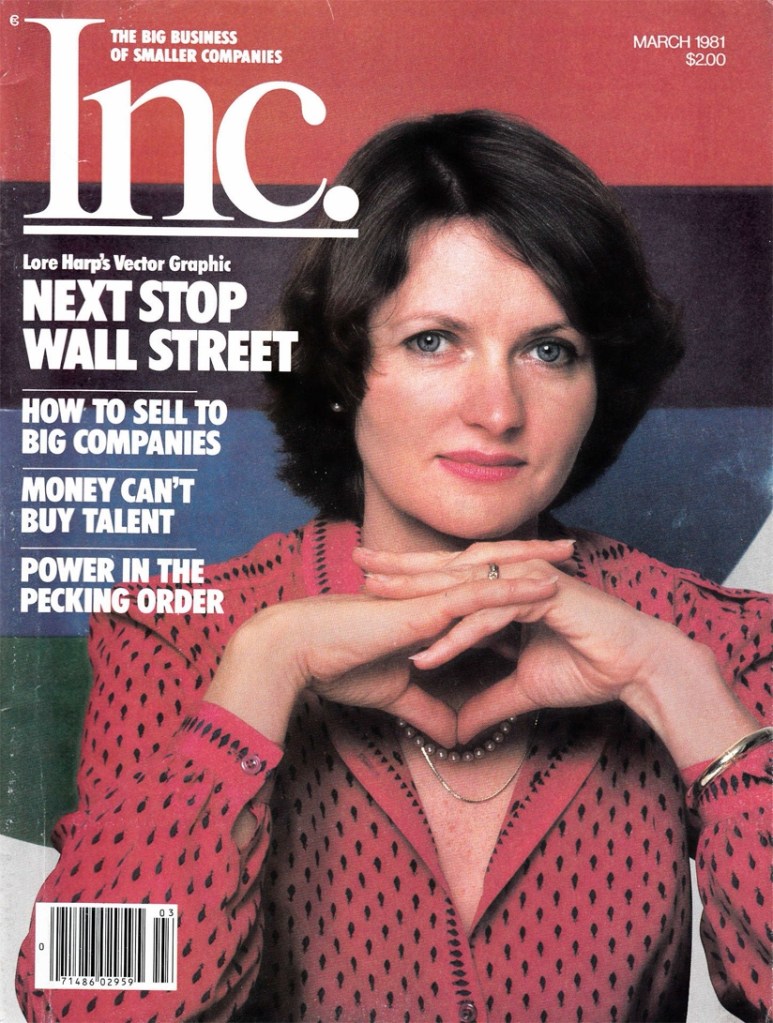
Over the years that business became quite substantial. Harp and Ely didn’t hesitate to take what advantage they could of the fact that they were women in a business dominated by nerdy, often reclusive men, who “all wanted to help ‘the girls’.” But they also lavished more attention on customer service than their more careless rivals, who tended to follow Altair’s practice of simply collecting checks and throwing product (of possibly indifferent quality) out the door. Like Processor Technology, Cromemco, and others, Vector graduated from making Altair accessories to making a full-scale Altair competitor. Their first complete S-100 computer, the Vector 1, became available in 1977. Because they sold full-featured and expensive products ($4,000 to $25,000 dollars) to small businesses, the arrival of the lower-cost Trinity that same year didn’t threaten them much. By the fiscal year ending June 1981, Vector Graphic made $2.5 million in profits on $25 million in sales.[27]
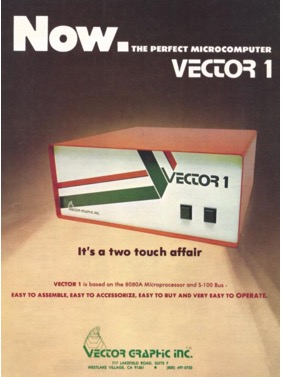
This business ran on CP/M. In the late 1970s, anyone who wanted to use a personal computer for serious work adopted floppy disk drives for external storage instead of paper tape or cassettes; by the early 1980s those with the budget even acquired so-called “Winchester” drives (or hard disks). But different manufacturers had different disk communication standards, and their disk had to interface with incompatible computers made by hundreds of different manufacturers. Gary Kildall’s CP/M cut across this Babel; he designed it to be easily configured to support any computer or external storage drive, and it quickly became the common software platform for a wide variety of computer makers. By 1981, over five-hundred software packages were available for CP/M, including Vector Graphic’s all-in-one word processing system, Memorite (their equivalent to the DECMate).
Vector Graphic went public with a $13 million IPO just months after the launch of the IBM PC; Harp aimed to expand It into a $200 million company by 1985. Things began to go sour shortly thereafter, as the Harps divorced and Bob started his own company, costing Vector its primary technical leader. Like Apple, they had no 16-bit computer ready to meet IBM’s challenge, and unlike Apple, they had no back-up plan. Worst of all, Vector leadership put their strategic bets on the victory of CP/M over MS-DOS, a gamble that turned out poorly.[28]
It was not so obviously foolish an idea as it may seem in retrospect. Many in 1982 were still betting on the entrenched strength of the CP/M ecosystem to repel IBM’s challenge in the business sector, just as Apple continued to hold the line in education. James Fallows, a journalist who had converted to writing by computer in 1979, advised Atlantic readers in the July 1982 issue that
…the war of standardization for personal computers is just about over. …The winner was a DOS [disk operating system] called CP/M. …Almost any kind of computer you buy these days will be compatible with CP/M, and almost any kind of software will come in CP/M versions. To put it another way, you should be wary of any machine or any program that won’t run CP/M.[29]
But Fallows, like Vector Graphic, miscalculated. CP/M’s head start was not as strong as it seemed, because it was not a complete hardware standard in the way that the IBM platform became. For example, disks written on one CP/M computer could not necessarily be read on another if their floppy drives didn’t use a compatible recording format. Both users and software makers were incentivized to jump to a completely standardized ecosystem.
Because of that, because of Lotus 1-2-3, because of the PC’s support for large memories, and because of the IBM name, MS-DOS, not CP/M, would be the winning DOS. After many quarters of losses, Vector filed for bankruptcy in 1985, the year that Harp had hoped to reach a fifth of a billion in market value. Harp, having semi-retired (handing off leadership to a former Honeywell executive) and then attempted a comeback, resigned for good in 1984.[30]
After 1985, the S-100 and CP/M ecosystem slid into the same state of living death as that of the TRS-80, with money still to be made in software and accessories, but few new customers. To survive, computer makers either moved into highly-specialized niche markets (like Cromemco)—a pivot that Vector attempted but fumbled—or caved to the IBM wave and began making PC-compatibles.[31]
A Valediction
In the long run, through the growing volume of PC-compatibles, the IBM wave would swamp even IBM itself. In that same long run, the greatest beneficiaries of the PC were the suppliers who acted as gatekeepers for every maker of those compatibles: Intel (for its microprocessors) and Microsoft (for its operating system).
Intel built its business in the 1970s on making memory, specifically dynamic random-access memory (DRAM). But as the that business became commodified in the 1980s, profit margins became ever slimmer and threatened to go negative. Becoming the microprocessor supplier for nearly every personal computer sold placed them in the position to rake in immense profits in the years to come.[32]
Up to 1981, Microsoft operated primarily as a machine tool business. Microsoft programming languages were the lathes and milling machines on which others cut their software. It was a lucrative business but with an inherently limited scope. The IBM PC (and Gates’ savvy dealing) had put them in control of the platform on which all that software would run; and many more people (and businesses) ran software than wrote it.
The full telling of the story of the clones and the rise of Intel and Microsoft, however, belongs to another series, to follow this one, with which I intend to carry the story of the personal computer forward to the mid-1990s. In the meantime, look out for A Bicycle for the Mind to appear in book form. The book will include a proper conclusion and additional material on early online services, the cultural dimensions of the personal computer, and the growth of personal computers outside the United States.
.
[1] Chposky and Leonsis, Blue Magic, 127; “Eagle Computer Chief Talks About the IBM World,” Computerworld (December 12, 1983), 15; David Bunnell, “Tecmar’s Triumph: A Decade of Success,” PC Magazine (September 1982), 31-41.
[2] Stan Veit, Stan Veit’s History of the Personal Computer, 243-246.
[3] Glenn Rifkin and George Harrar, The Ultimate Entrepreneur: The Story of Ken Olsen and Digital Equipment Corporation (Chicago: Contemporary Books, 1988), 196-199; Jamie Pearson, “Interview with Andy Knowles,” DEC Oral Histories (April 5, 1990), 20 [https://archive.org/details/bitsavers_dechistoryowles900405_1130289]. The PDT, you may recall, had almost enticed Dan Bricklin to make it the target platform for what became VisiCalc, before he learned about the new up-and-coming hobby computers.
[4] Rifkin and Harrar, The Ultimate Entrepreneur, 199-200.
[5] “Gordon Bell,” DEC Oral Histories (June 28, 1991), 23 [https://archive.org/details/bitsavers_dechistoryBell910628_4987654].
[6] Rifkin and Harrar, The Ultimate Entrepreneur, 201-202, 208; Avram Miller, “Chapter 6: Going Digital” in The Flight of a Wild Duck (May 23, 2026) [https://avram.substack.com/p/chapter-6-going-digital].
[7] Rifkin and Harrar, The Ultimate Entrepreneur, 209.
[8] Rifkin and Harrar, The Ultimate Entrepreneur, 204, 209; Miller, “Chapter 6: Going Digital.”
[9] Rifkin and Harrar, The Ultimate Entrepreneur, 210-211.
[10] Rifkin and Harrar, The Ultimate Entrepreneur, 204, 214-215.
[11] Miller, “Chapter 7: Right Bird, Wrong Nest” in The Flight of a Wild Duck (May 24, 2026) [https://avram.substack.com/p/chapter-7-right-bird-wrong-nest]; Rifkin and Harrar, The Ultimate Entrepreneur, 237; Wesely Melling, “Digital’s Professional 300 Series: A Minicomputer Goes Micro,” BYTE (June 1983), 96-102, 106.
[12] John J. Snyder, “A DEC on Every Desk?”, BYTE (June 1983), 104-106; Miller, “Chapter 6: Going Digital”; Rifkin and Harrar, The Ultimate Entrepreneur, 238, 241.
[13] Rifkin and Harrar, The Ultimate Entrepreneur, 242; David Allison, “Ken Olsen Interview,” National Museum of American History (September 28-29, 1988) [https://americanhistory.si.edu/comphist/olsen.html#tc35].
[14] Williams, “A Closer Look at the IBM Personal Computer,” 40.
[15] Ron White, “The Tandy Story,” 80 Micro (August 1987), 64.
[16] Ron White, “The Tandy Story,” 80 Micro (August 1987), 60-64.
[17] David Welsh and Theresa Welsh, Priming the Pump: How TRS-80 Enthusiasts Helped Spark the PC Revolution (Ferndale, Mich.: Seeker Books, 2013),320-323.
[18] Apple Computer, “Welcome IBM, Seriously,” Wall Street Journal (August 22, 1981).
[19] Walter Isaacson, Steve Jobs (New York: Simon & Schuster, 2011), 135; Chposky and Leonsis, Blue Magic, 110; Chris Morgan, “Of IBM, Operating Systems, and Rosetta Stones,” BYTE (January 1982), 6-10.
[20] Frank Rose, West of Eden: The End of Innocence at Apple Computer (New York: Viking, 1989), 72-74; Michael S. Malone, Infinite Loop: How Apple, the World’s Most Insanely Great Computer Company, Went Insane (New York: Doubleday, 1999), 249-250; Barbara E. McMullen and John F. McMullen, “Apple Charts the Course for IBM,” PC Magazine (February 21, 1984), 122-129. The Xerox Star, released in 1981, was another extremely capable computer that flopped because of its high cost. Companies kept making this mistake because they compared upward to minicomputer prices (relative to which their computers were quite reasonably priced for their capability). But the comparison was false: minicomputers were bought by and for organizations and almost always intended as shared resources. Shoppers looking for computers for an individual user compared downward to other personal computers, and almost always opted for a cheaper alternative.
[21] William Aspray, “Oral History of Mitch Kapor,” Computer History Museum (November 19, 2004), 8-13; Andy Goldstein, “Mitchell Kapor,” IEEE History Center (May 20, 1993) [https://ethw.org/Oral-History:Mitchell_Kapor].
[22] Denise Caruso, “Company Strategies Boomerang,” InfoWorld (April 2, 1984), 80-83; Richard P. Rumelt, “Visicorp 1978-1984 (Revised),” (2003), 4 [https://www.anderson.ucla.edu/faculty/dick.rumelt/Docs/Cases/Visicorp.pdf]; Microsoft, “The History of Microsoft – 1976” (February 12, 2009) [https://learn.microsoft.com/en-us/shows/history/history-of-microsoft-1976].
[23] Thomas C. Hayes, “Eagle Computer Stays in the Race,” New York Times (October 24, 1983). Apple’s primacy as a platform for adventure, role-playing, and simulation games lasted for a few more years. Sierra cut a deal with IBM to make the initial release of King’s Quest (1984) exclusive to the PC Jr., then did a simultaneously release of King’s Quest II (1985), and finally switching to an IBM PC-led release schedule with King’s Quest III (1986). Other game companies, like Sir-Tech, held out far longer, focusing its releases on the Apple II all the way up to 1988’s Wizardry V: https://en.wikipedia.org/wiki/King%27s_Quest_I#Development; https://en.wikipedia.org/wiki/King%27s_Quest_II#Development_and_release; https://en.wikipedia.org/wiki/King%27s_Quest_III#Development_and_release; https://en.wikipedia.org/wiki/Wizardry_(video_game_series).
[24] Thom Hogan, “State of Microcomputing,” InfoWorld (September 14, 1981), 10-12; “Recent Releases,” Unix Review (April 1986), 75. This ecosystem had its own magazine, Microsystems, which documented 500 related products from 150 companies in its May 1984 issue: Sol Libes, “S-100 Product Directory,” Microsystems (May 1984), 59-67.
[25] Marguerite Zientara, Women, Technology and Power: Ten Stars and the History They Made (New York: AMACOM, 1987), 29-30.
[26] Zientara, Women, Technology and Power, 29-30, 167.
[27] Nancy Ann Nichols, Reach for the Top: Women and the Changing Facts of Work Life (Boston: Harvard Business Review, 1994), 162-163, 170, 175; Zientara, Women, Technology and Power, 162; Daniel F. Cuff, “A Honewell Executive to Run Vector Graphic,” New York Times (May 25, 1982).
[28] Zientara, Women, Technology and Power, 106, 169; Nichols, Reach for the Top, 175; Michael S. Malone, “Can Vector Do It Again?” New York Times (July 10, 1983).
[29] James Fallows, “Living with a Computer,” Atlantic (July 1982) [https://www.theatlantic.com/past/docs/issues/82jul/fallows.htm].
[30] Malone, “Can Vector Do It Again?”; “Head of Vector Resigns,” New York Times (March 22, 1984); ”Vector Files for Protection,” New York Times (December 25, 1985);
[31] Zientara, Women, Technology and Power, 171; Elizabeth Rannay, “Thriving in a Shrinking Market,” InfoWorld (August 19, 1985), 27.
[32] Robert A. Burgelman, “Fading Memories: A Process Theory of Strategic Business Exit in Dynamic Environments,” Administrative Science Quarterly 39, 1 (March 1994), 24-56.


