In memory of Clement J. McDonald, Junior, 1940-2026
Beloved husband, loving father, incomparable colleague and generous mentor
A sudden push from the industry,
A sudden grant in the fall,
By three R's left unguarded
They have entered our study hall.

They climb into the curriculum,
O’er plans, objectives, and goals,
If I try to escape, they surround me,
With carrels, consultants, and polls.

They almost devour me with data,
Hard copy is ever replete,
But it beats chalk dust and dittos[1],
And the students think that it’s neat

    -- from “The Computer Hour,” Robert C. Snider [https://archive.org/details/nea-lttr-dpt-ed.-don-senese-nat-tech-conf.-best-8-mar-1982].
Masters or Subjects?
The belief that computers would revolutionize education took root long before the microcomputer era; it had spread rapidly across American universities in the 1960s. The political and technical moment were both ripe: the Soviet launch of Sputnik in 1957 and Lyndon Johnson’s Great Society programs both catalyzed massive new flows of federal money into education, and into educational research in particular. Meanwhile, time-sharing, which allowed multiple users to simultaneously access a single large, expensive computer, made it conceivable to teach whole classrooms of students at once by computer (though this was still very expensive, given the price of computers at the time).
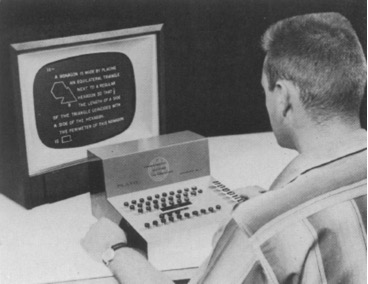
Two of the earliest time-sharing systems—the Dartmouth Time Sharing System (DTSS) at Dartmouth College in New Hampshire, and the PLATO system at the University of Illinois—were created specially for educational purposes, and both were backed by government grants, from the Office of Naval Research (ONR) and National Science Foundation (NSF), respectively—PLATO would later get NSF money as wel). (We have already encountered both of these systems in other contexts: DTSS as the origin of the BASIC computer language, and PLATO as a source of inspiration for some early microcomputer games.)[2]
The educational rationales that motivated PLATO and DTSS were very different, however. PLATO came out of the tradition of “teaching machines”: mechanical or electro-mechanical devices that presented a sequence of instructional material to the student, allowing them to advance to the next item only after a correct answer. The promoters of teaching machines (most prominently, Sidney Pressey in the 1920s and 1930s and B.F. Skinner in the 1950s and 1960s), promised to bring the industrial revolution to education by automating course material. But unlike the mass-produced homogeneity of industrial products, teaching machines would offer personalized instruction that would move as fast or slow as a given student required, giving each the equivalent of a private tutor. The reach of the teaching machine, however, exceeded its grasp: as one critic put it, despite their revolutionary ambitions, they were little more than “expensive page turners.”[3]
An electronic computer could do far more than Pressey and Skinner’s simple machines, however, and the field of computer-aided instruction (CAI) that emerged in the early 1960s aimed to tap into that flexibility to realize the promise of the teaching machine. PLATO (one of those absurd backronyms, Programmed Logic for Automatic Teaching Operations) was the most long-lasting and best known computer system to emerge from the CAI movement. It began as a simple computerized teaching machine that presented a series of slides to students. But its later iterations used graphical terminals, could move arbitrarily through instructional material, without having to follow a pre-set linear sequence, and could present interactive materials (such as a simulated, open-ended chemistry lab) that were impractical to recreate on paper.
Despite its much greater power, the sales pitch for PLATO was the same as that for the teaching machines that preceded it: to offer each child automatic and individually-paced instruction, accelerating their absorption of the time-honored curriculum of math, reading, science, and so forth. The Cold War competition with the Soviet Union in this post-Sputnik moment fused with Great Society concerns about failing urban schools to give a sense of urgency to the search for more efficient and effective teaching methods, and also justified the large grants required to fund the use of expensive computer time by undergraduates or even high school students.[4]
The premise of the Dartmouth Time-Sharing System, on the other hand, was that students would use computers to learn about computers. As we have already mentioned, DTSS was created by John Kemeny and Thomas Kurtz as a metaphorical open-stack library for computing, and they introduced the BASIC computer language to make computer programming accessible to every undergraduate. Kemeny, head of the Dartmouth math department, observed that computers were already becoming essential to many areas of research, and foresaw that they would become involved in all parts of life in the near future. Whereas CAI enthusiasts wanted to bring the efficiencies of the industrial revolution to instruction, DTSS treated the computer itself as a new industrial revolution which the country’s prospective future leaders (Dartmouth undergrads) would need to understand in order to prevent a technocratic takeover. As Kemeny wrote in 1966:
…all businesses, and most private lives, will be influenced by computers. Whether this is going to be a fully favorable effect, as it could be, or a very harmful one will depend on whether the people who make the policy decisions know what computers can do and what they can’t do, or whether they blindly trust the people who run the machines.[5]
But such an elite-centered vision of computing could not justify the wider introduction of computers to students across all colleges and schools. It reemerged in the 1970s in a diluted form as “computer literacy,” a term coined by one of Kemeny and Kurtz’s colleagues at Dartmouth, Arthur Luehrmann. Leuhrmann teased CAI proponents for pushing the equivalent to “Writing-Assisted Instruction,” when what students really needed was to learn to write:
But there is a higher goal. If the computer is so powerful a resource that it can be programmed to simulate the instructional process, shouldn’t we be teaching our students mastery of this powerful intellectual tool? Is it enough that a student be the subject of computer administered instruction—the end-user of a new technology? Or should his education also include learning to use the computer… These uses of computers in education cause students to become masters of computing, not merely its subjects.[6]
Hope and Fear
Such were the intellectual roots that grounded the arguments for bringing microcomputers to schools in the 1980s. But they were shallowly dug, poorly watered by empirical fact, and frequently tangled. (We have already seen that as early as 1965, DTSS, designed to give future leaders mastery over the computer, was being used to deliver math drills to Minnesota high school students.) In practice, the motivation for adopting computers in schools was more often emotional than intellectual: dazzling optimism about the capacity of technology to solve social problems mixed with a fear of being left behind and missing out on the future.
Fear that American science was falling behind the Soviets had fueled the initial burst of interest in educational computing in the 1960s, in the wake of Sputnik. By the early 1980s, such worries about losing the Cold War were compounded and even eclipsed by fears of the rising economic threat of Japan. Japanese inroads into traditional areas of American manufacturing strength like automobiles were already alarming enough, but Japanese companies had also begun an assault on high-tech industries, from memory chips to computer systems.[7]
A broad streak of anxiety about Japan shows through in the testimony at hearings held for the 1982 Computer Contribution Act (a.k.a. the “Apple Bill”). One witness called Japan’s rising influence in computer systems “a new ‘Sputnik’.” Al Gore, Jr., then a representative for Tennessee, speaking in favor of the bill, reminding his listeners that “[w]e are constantly made aware of our need to catch up with the Japanese… we have all heard that litany.” This unease at a rising competitor was accompanied by an underlying suspicion that the Japanese were not playing fair. Just days after the hearing, news broke of an FBI sting that caught Hitachi and Mitsubishi employees attempting to purchase purported IBM technical documents.[8]
Thus, an urgent need for “computer literacy” dominated the public discourse about computers in schools in the 1980s. Sometimes this well-meaning attempt to prepare students for the information age maintained a clear lineage with the ideas of Kemeny and Luehrmann: “Some believe that all children,” wrote Beverly Hunter, a computer programmer turned educator, “…must learn to take control of the machines before the machines take control of them. According to this view, computer literacy is a matter of self-defense.”[9] But public figures like Gore more often brandished computer literacy as a kind of jobs training program for maintaining American competitiveness. According to him, it was the fulcrum on which the fortunes of the American youth would rise or fall:
…computer literacy is becoming a necessary tool as our Nation and the world moves into a new era of high technology… the ability to incorporate basic computer literacy into the skills of our young people could be the difference between a generation of occupational misfits or a rapid growth in productivity at all skill levels of our economy.”[10]
A 1982 New York Times article perfectly captures the hope, fear, and uncertainty that was brewing in intellectual circles around computers in education, and signaled its overflow into popular discourse. Edward Fiske, the Times’ education editor, surveyed the varied range of opinions about how to use computers in schools, and about the urgency of their introduction, from Donald Michael’s book The Unprepared Society (“Ignorance of computers… will render people as functionally illiterate as ignorance of reading, writing and arithmetic”) to Richard Cyert, president of Carnegie-Mellon (on computer-aided instruction: “[w]e tried it for two or three years, but it did not work out… [t]he usage did not seem to be that high.”)[11]
The confusion about exactly what computers would do for students was reflected in schools themselves. Because of the number of computers available, only a small fraction of each student’s instructional time could be in front of a computer, and computer literacy had a clear emotional power: who wants their child to be illiterate? So computer literacy, not computer-aided instruction, became the predominant way of defining instructional goals and curricula around computers and justifying their introduction to schools.
The typical computer literacy curriculum was a grab bag of keyboarding, CAI, general computer knowledge, word processing, and a smattering of programming. Classes were typically taught by science teachers dragooned into an unfamiliar subject after some brief in-service training, under the constraints of limited computer time and limited ability to cut into instructional time for traditional subjects.
Keyboarding was the most broadly useful skill among this potpourri, but of course this was also known as typing, and predated microcomputers by a century. The rest was unlikely to be either necessary or sufficient to prepare oneself for a later job involving computers, whether a high-status job in electrical engineering or computer programming, or one closer to the median in data entry or retail. Its primary benefit was probably, as Jobs foresaw, to spark interest in a select few who became passionate about computers, but it was impossible to politically justify a nationwide investment in computer education on that basis.[12]
Educators, of course, also depended completely on the software that was available, which gave function to the otherwise inert classroom computer. Educational software can be roughly grouped into three basic flavors, which I will (somewhat flippantly) categorize as conservative, progressive, and ludic.
Conservative Software
However much schools might structure their curriculum around the concept of computer literacy, the vast majority of software in schools by volume was conservative, and designed for computer-aided instruction (CAI), literally speaking.
Conservative software fit into pre-existing curricula, and reinforced pre-existing learning objectives. Often called “courseware,” it was based on the assumption that the computer was fundamentally supplemental to existing classroom methods. Textbook publishers, seeing the classroom computer as a new revenue stream, got into this segment early: McGraw-Hill already had a courseware strategy laid out in its 1981 annual report. But even when issued by a well-known publisher, most of the software came from individual teachers and entrepreneurs, who, per one scholar, “had tremendous leeway in defining what qualified as ‘educational,’ and in many cases the sheer presence of the computer, applied to standard learning exercises, was enough to excite children and teachers alike.”[13]
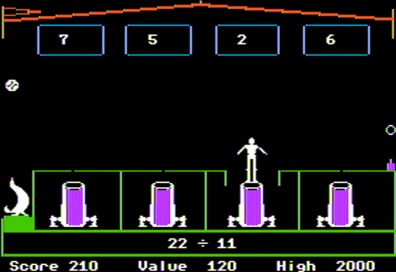
The amount of pains courseware authors took to engage seriously with their new medium varied widely. Their designs rose through three gradations of sophistication. The base of the pyramid consisted of a mass of unimaginative, low-effort drills; that is to say, extremely overpriced flashcards. One of the most successful of this genre was 1983’s Math Blaster!, which dressed up math drills like an arcade video game. There were even meta-programs to help teachers easily generate their own digital flashcards.[14]
The next level of complexity were tutorials, designed to guide a student through a set of course material, but most elaborate were the simulations, intended to impart concepts through hands-on, experiential learning. These included the more obvious digital translations of physics or chemistry labs, but also more original concepts like MECC’s Odell Lake.
There were even math simulations. One such, Visible and Tangible Math opened up new ways for students to explore the possibilities of arithmetic. For example, it might present the student with a difficult-looking subtraction problem, such as “453 – 199”. The student can use + and – buttons to adjust the values on both sides of the subtraction sign (in this case, with the expectation that they will discover they can transform the problem into the simpler “454 – 200”). As one admirer of the program put it, “[f]irst, the computer suggests fruitful transformations and does much of the computational work; later, these jobs are transferred to the students, to make them independent of the computer.[15]
This kind of supplemental application of CAI to traditional instructions probably did modestly improve learning outcomes, but other approaches to computer education hoped to do much more.[16]
Progressive Software
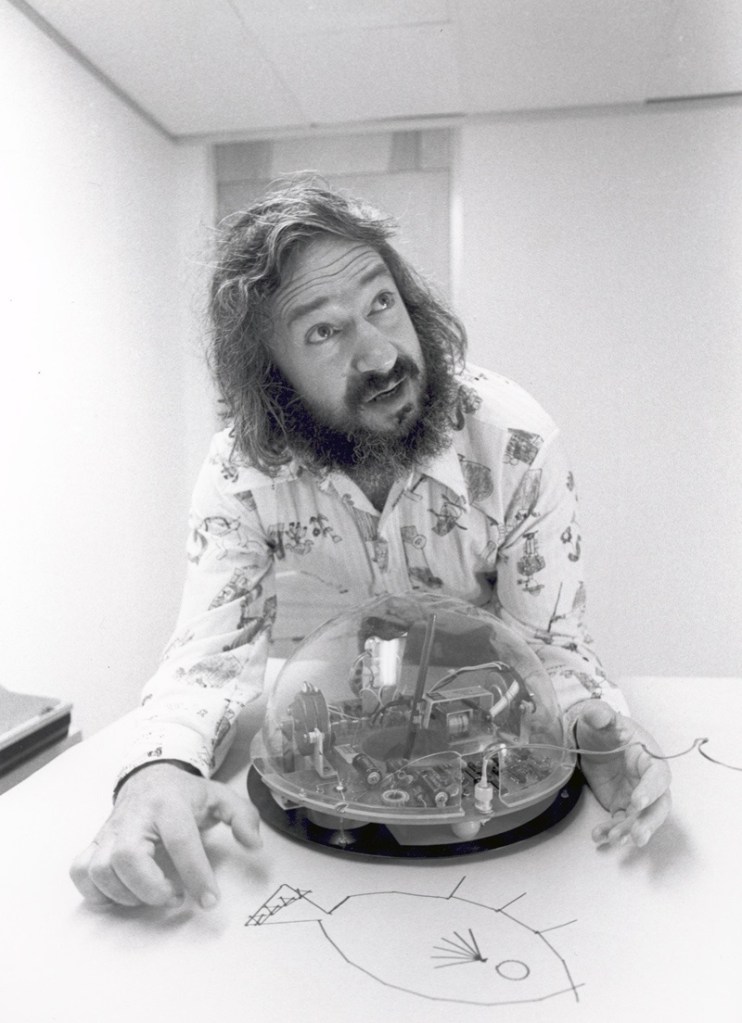
Exploratory CAI software like Visible and Tangible Math bordered on progressive territory. Progressive educational software drew on critiques of traditional schooling that dated back decades to the likes of Maria Montessori, but intensified in the 1960s with polemics by John Holt, Ivan Illich, and others. In the 1980s, this segment of educational software was dominated by the vision of one man: Seymour Papert.
A South African-born political radical, trained as a mathematician, but apprenticed as a disciple of the Swiss pedagogical theorist Jean Piaget, Papert joined MIT as a researcher in 1963 and became co-director of its Artificial Intelligence lab in 1967. Inspired by his own first transformative encounters with computer programming at MIT, he became convinced that computers, when harnessed to Piaget’s theoretical framework, could remake education.
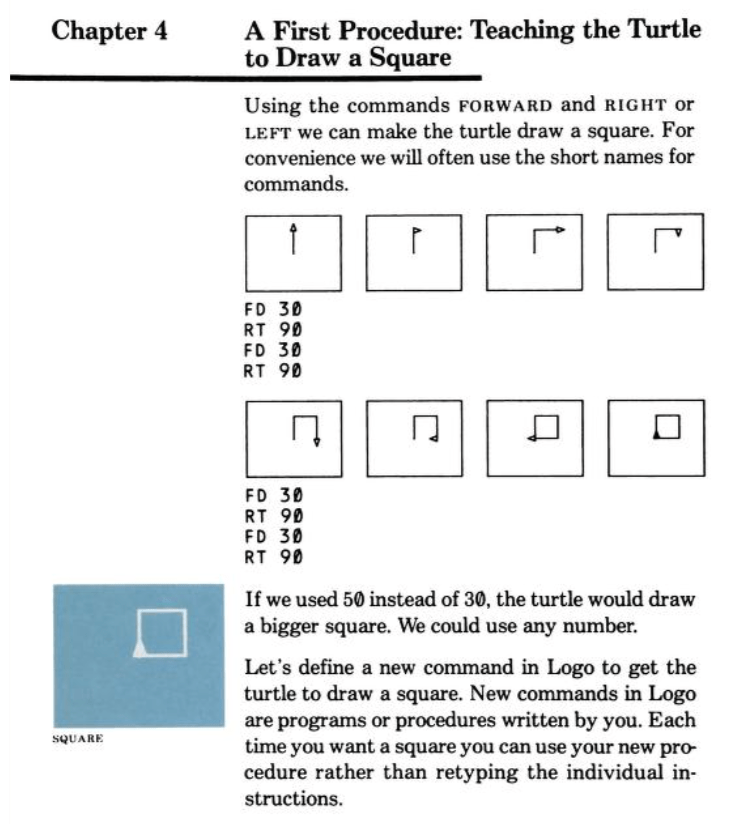
In 1969 he borrowed the streamlined Logo programming language from the educational technology group at nearby Bolt, Beranek and Newman (BBN), and used it to feed instructions such as “FORWARD 100” and “LEFT 45” to a robot he called a “turtle.” These simple instructions that produced obvious and gratifying real-world effects presented children with a gentle pathway into the world of algorithms (what later theorists would call “computational thinking”). Hal Albelson, a mathematician working with Papert on Logo, transformed the physical turtle into a much more cost-effective graphical cursor that could move around a computer screen, leaving a line in its wake. Children first encountering Logo could quickly draw a square or triangle in “turtle graphics,” and as they advanced in skill could generate ever-more sophisticated patterns. From that point forward, Papert made it his calling to provide every child with the ability to learn through a computer.[17]
The rise of the personal computer was an obvious boon to this program. Papert met the moment in 1980, with a book that caught the rising wave of interest in bringing computers into schools, Mindstorms: Children, Computers, and Powerful Ideas. Logo became one of the most popular pieces of educational software in the ensuing decade. Though his emphasis on technical mastery bore a superficial resemblance to the computer literacy tradition, Papert had something more radical in mind. “I see the classroom,” he wrote,
…as an artificial and inefficient learning environment that society has been forced to invent because its informal environments fail in certain essential learning domains, such as writing or grammar or school math. I believe that the computer presence will enable us to so modify the learning environment outside the classrooms that much if not all the knowledge schools presently try to teach with such pain and expense and such limited success will be learned, as the child learns to talk, painlessly, successfully, and without organized instruction.
Unlike conservative courseware that “programmed the child” to follow its pre-existing logic, learning via Logo would allow children to build “their own intellectual structures.” Once mastered, the computer, with its infinite flexibility, could be the gateway to any kind of learning the child desired.[18]
Papert and other Logo stalwarts at MIT formed a private company, Logo Computer Systems Inc., to sell microcomputer versions of the Logo programming environment, including an Apple II version written by Abelson. By 1983 they had ported it to fifteen different computer models, and by 1986 had sold 150,000 copies for the Apple II alone. But of course, schools did not adopt Logo in order to dissolve themselves out of existence, as Papert evidently hoped, but to meet goals for computer literacy. Their new curricula demanded that they give students a basic familiarity with programming, and Logo was a ready-made learning environment designed (so it seemed) to do exactly that. It could even act as a kind of CAI, fulfilling instructional goals in the pre-existing math curriculum.[19]
So, to his dismay, but to little surprise for the historical observer, Papert’s radical program was co-opted to conservative ends. Papert’s computer-centric approach to learning was doomed in any case by the economic realities of computers in the 1980s: an elementary school with hundreds of students and perhaps a dozen computers in total could not recenter its school day around student-led use of computers (in 1985 the ratio of students to computer in American schools was about fifty to one). Even were it practically possible, the median elementary school teacher, with no training in or predilection for computer science, was not prepared intellectually or culturally to guide students through a process of self-actualization via mastery of the computer. The Logo fad gradually petered out, and teachers and administrators went in search of other ways to impart computer literacy.[20]
Ludic Software
If CAI programs like Math Blaster! toed the line between teaching tool and game, the last branch of educational software obliterated it. Ludic software started from the assumption that fun acted as a lubricant to learning: the first task of the software was to attract the student’s attention, then they could absorb the instructional lessons, almost subliminally. This closely mirrored the sales pitch of the home computer makers, that they would make learning feel like fun. The risk in both cases, however, was that they would instead make fun look like learning.
I have already mentioned Spinnaker Software’s Snooper Troopers (1982)in the context of the home computer: a kind of adventure/mystery that required players to search houses for clues to gather information to identify and catch a criminal. it was marketed mainly to parents (Spinnaker explicitly advertised its products as games, but games “you want your kids to play”) but also popular in classrooms.
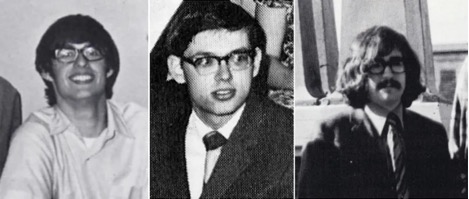
Spinnaker was perhaps the first entirely cynical microcomputer software company. Its founders, Harvard Business School graduates, had no particular interest in computers or software per se. They simply saw a business opportunity to take command of a sector led by amateurs who had no notion of how to market products through mass-media channels. When surveyed, retailers told them that they could not get enough educational software to meet demand, and so that was the segment they targeted. As media scholar Laine Nooney put it, “There was no gawky adolescent Spinnaker, no charmingly awkward stage where the principals were copying disks in their kitchen or typesetting their own ads.” Tom Snyder, Snooper Troopers’ creator and a middle school teacher, was sincere about reaching children through collaborative instruction and “very skeptical about the use of computers in classrooms.” But he had no say in the publisher’s strategy.[21]
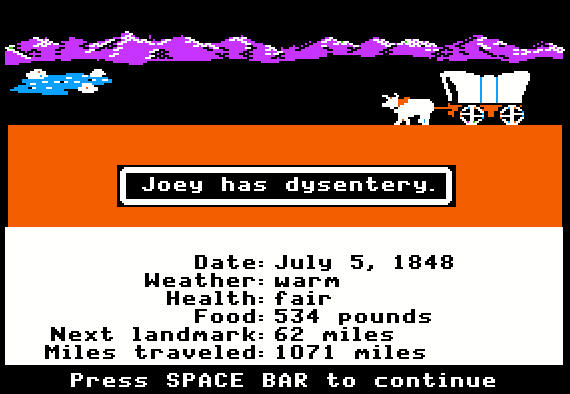
Brøderbund’s 1985 mystery-adventure Where in the World Is Carmen Sandiego? followed the Snooper Troopers playbook and was an even bigger success. But the canonical example of ludic educational software was MECC’s own Oregon Trail (sometimes called simply Oregon). In fact, the first version of Oregon Trail predated even MECC, dating back to 1971. It was written in BASIC by three student teachers at Carleton College, about forty miles south of Minneapolis. Don Rawitsch, a senior who was teaching eighth-grade history, originally began the project as a paper-based boardgame, but two roommates with programming experience, Bill Heinemann and Paul Dillenberger, convinced him it would be easier to manage on a computer which they had access to via the schools where they taught: the Hewlett-Packard minicomputer purchased recently by the Minneapolis educational cooperative, Total Information for Educational Systems (TIES).[22]
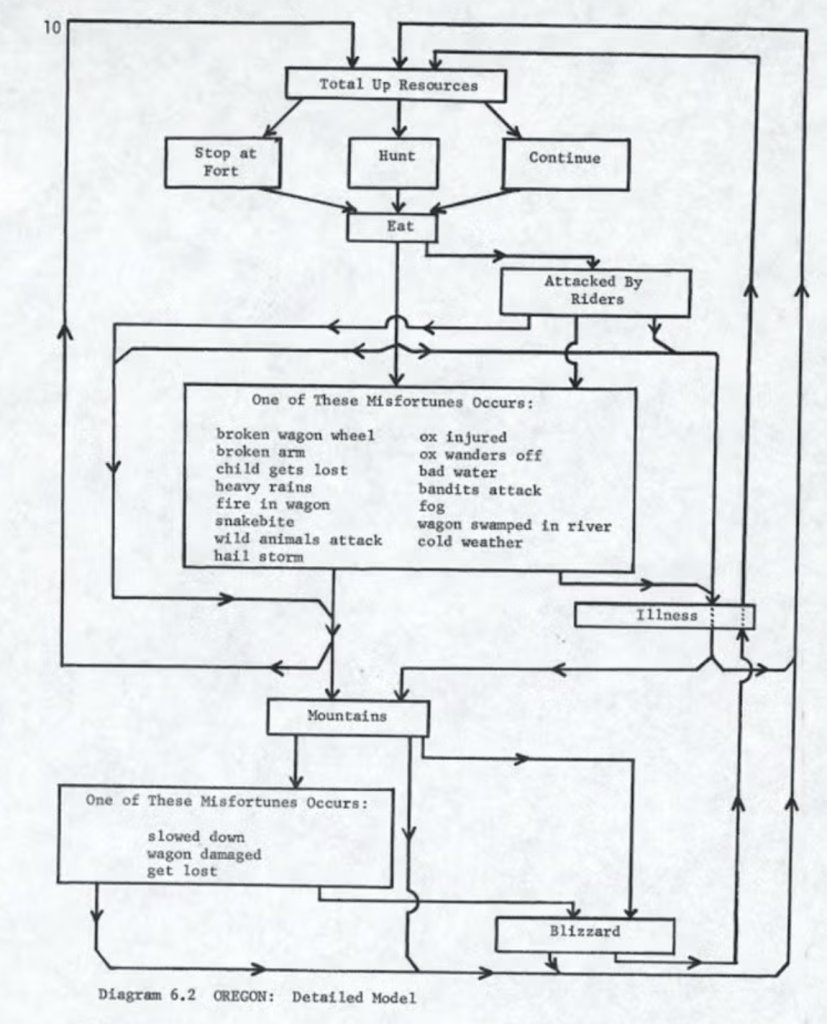
In 1974, Rawitsch was hired by MECC, and re-entered his program into the MECC system, revising it in the process to add more fun and historicity. He published it with additional revisions in a six-hundred-line listing in Creative Computing in 1978, and MECC ported it to the Apple II with the addition of some rudimentary graphics in 1980. The game played out over a series of biweekly turns, with the main decision points being the initial allocation of money among food, ammunition, and other supplies, and when to stop and take time to hunt or restock at an army fort. Each turn would bring a chance of “misfortune,” and you lived or died based on how well you were able to weather this gauntlet of random events. Rawitsch based the historical framework of the game on William Ghent’s 1929 Road to Oregon and Ezra Meeker’s 1907 Ox Team Days on the Oregon Trail and set the frequency of misfortunes (illness, poor weather, wagon trouble, etc.) based on their rate of occurrence in three travel diaries. The 1985 full-color Apple II version by R. Philip Bouchard (probably the most widely-played version of the game) turned the hunting process from a simple test of timing into an arcade-like shooting gallery and included several new features and decisions (such as how to manage hazardous river crossings).[23]
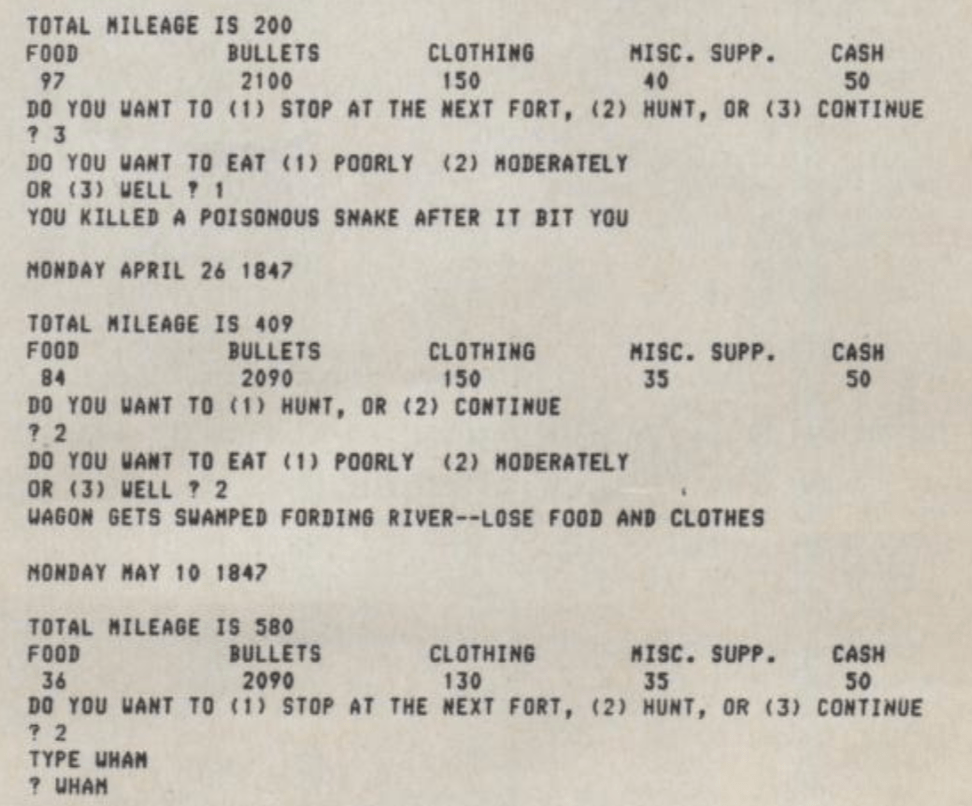
Oregon Trail had some obvious precursors in resource-management games like Hammurabi and especially Civil War (which required the player to allocate money to food, troop salaries and ammunition over a series of fourteen battles). Both were originally created on DEC systems in 1968. A version of Civil War existed on the TIES minicomputer, and may have been a direct or indirect influence, although no sources cite it as such. But what is surprising its Oregon Trail‘s lack of successful imitators. Oregon Trail constituted the bulk of the value of the privatized MECC, and new iterations of the game continued to appear well into the twenty-first century, but no other educational simulation game has come remotely close to matching its popularity.[24]
That a simulation of the Oregon Trail became a formative memory for a generation of American children is a curious fact. Not the American Revolution, not a pivotal presidential election, not the Civil War or the World Wars, not slavery or the civil rights movement. As a matter of sheer historical accident, a game about one path of westward settlement traveled by perhaps half a million people became the piece of software for teaching history through computers. Like other ludic educational software, Oregon Trail was extremely successful in terms of commerce and even memetics, but probably much less so in terms of pedagogy. Per one professor who observed students at Old Orchard Junior High School in Skokie Illinois:
From our observations, Oregon Trail is liked mostly by boys who enjoy shooting animals for food. Girls may like this game too, but for other reasons — reaching the destination, writing epitaphs on tombstones, etc. To some degree, the educational objectives of the game are missed. Attributes that were intended to attract children to the game actually divert their attention from the objectives.[25]
If the microcomputer was good for anything, it was certainly good for play.
From Novelty to Normalcy
Between 1980 and 1984, public schools in the United States added 500,000 computers to their classrooms. What began as a scattered movement by enthusiastic individuals gradually became normalized and integrated into school district bureaucracies. Walter Koetke, a high school teacher and early promoter of computers in education, noticed this phenomenon as early as 1982:
…the instructional use of microcomputers seems to be moving away from the “local hero” doing his or her thing to a more structured system- wide approach. This follows quite naturally as administrators become uncomfortable with a proliferation of hardware without someone providing coordination and direction for its use.[26]
However confused the original purpose and function of classroom computers, they became by the mid-1980s an unquestioned necessity. That schools were obligated to expose their charges to the basics of the computer became an accepted fact-of-life of twentieth-century schooling.
This mirrored a broader trend of personal computing: in a handful of years it went from curiosity that large organizations ignored, to an experiment that a few early adopters within large organizations took up, to a requirement that large organizations controlled. Nothing better embodied this transformation than the IBM Personal Computer.
[1] The “ditto” was a form of copy machine: https://en.wikipedia.org/wiki/Spirit_duplicator.
[2] “PLATO II – University of Illinois, Urbana, Ill.,” Office of Naval Research Digital Computer Newsletter (October 1961 – April 1962), 18-24. [https://web.archive.org/web/20180726004548/http://www.dtic.mil/dtic/tr/fulltext/u2/694637.pdf]
[3] L. T. Benjamin, “A History of Teaching Machines,” American Psychologist 43, 9 (1988), 710; Bob Johnstone, Never Mind the Laptops: Kids, Computers, and the Transformation of Learning (Lincoln, NE: iUniverse, 2003), Kindle location 250-450; Donald L. Bitzer and Peter G. Braunfeld, “Computer Teaching Machine Project: PLATO on ILLIAC,” Computers and Automation (February 1962), 16-18.
[4] Johnstone, Never Mind the Laptops, Kindle location 126, 636, 725-800.
[5] John Kemeny, “The Computer at Dartmouth,” Dartmouth Alumni Magazine (February 1966), 16.
[6] Arthur Luehrmann, “Should the computer teach the student, or vice-versa?”, Spring Joint Computer Conference (Spring 1972), 410.
[7] Michael S. Malone, The Big Score: The Billion Dollar Story of Silicon Valley (San Francisco: Stripe Press, 2021 [1985]), 277-280.
[8] “Hearings before the Subcommittee on Select Revenue Measures of the Committee on Ways and Means, House of Representatives, Ninety-seventh Congress, second session, on H.R. 4667, H.R. 4948, H.R. 5177…,” 20, 43; Charles Alexander, “Now, from the FBI: Japanscam,” Time (July 4, 1982).
[9] Beverly Hunter, My Students Use Computers: Computers Literacy in the K–8 Curriculum (Reston, VA: Reston Publishing Company, 1984), 6; Moser Funeral Home, “Beverly Claire Roberts Hunter
Obituary,” (ca. November 2017) [https://www.moserfuneralhome.com/obituaries/Beverly-Claire-Roberts-Hunter?obId=2790757]
[10] “Hearings before the Subcommittee…,” 20.
[11] Edward B. Fiske, “Schools Enter the Computer Age,” New York Times (April 25, 1982).
[12] Hunter, My Students Use Computers, 10-13.
[13] Nooney, The Apple II Age, 232, 237.
[14] John and Mary Harrison, “Computers in Education: Benefit or Bombshell?”, Antic (September 1983); “Tandy’s Educational Courseware,” Your Computer (March 1982), 58-59; Wikipedia, “Math Blaster!” [https://en.wikipedia.org/wiki/Math_Blaster!]; Walter Koetke, “Software Close-Up,” Creative Computing (March 1981), 136.
[15] Theodore F. Swartz, et. al., Educator’s Complete Guide to Computers (West Nyack, NY: Parker Publishing, 1984), https://archive.org/details/educatorscomplet0000swar/page/167/mode/1up?q=apple)
[16] Kathleen Cotton, “Computer Assisted-instruction,” School Improvement Research Series (May 1991) [http://educationnorthwest.org/sites/default/files/Computer-AssistedInstruction.pdf].
[17] Johnstone, Never Mind the Laptops, Kindle location 1420-1860.
[18] Seymour Papert, Mindstorms: Children, Computers, and Powerful Ideas (New York: Basic Books, 1980), 8-9; 19.
[19] Johnstone, Never Mind the Laptops, Kindle location 2130-2260. Abelson’s own Turtle Geometry, a 1982 book co-authored by Abelson, attempted to apply Papert’s philosophy to higher-level math teaching (for advanced high school students or undergraduates). It’s a fascinating book, but its discursive style and scattershot topical coverage would have made it impossible to fit into any kind of existing math curriculum.
[20] Johnstone, Never Mind the Laptops, Kindle location 2280, 2361-2435; “How Does a Teacher Manage with One or Two Computers?” Education News (Nov. 1983 – Jan. 1984), 9. Papert tries to counter the financial argument against universalizing computer use in schools, but his logic is questionable. Papert, Mindstorms, 17-31.
[21] Nooney, Apple II Age, 222, 233-239, 246, 253; “Profile of a Snooper Trooper,” Creative Computing (April 1983), 130.
[22] Robert Whitaker, “He Created the Oregon Trail,” Slate (November 17, 2021) [https://slate.com/news-and-politics/2021/11/oregon-trail-game-history-inventor-don-rawitsch.html]. I haven’t found a source explicitly stating that the computer used was part of TIES, but it’s an obvious inference from the fact that it was a HP minicomputer accessible from a Minneapolis school system.
[23] Dan Rawitsch, “Oregon Trail,” Creative Computing (May-June 1978), 132-139.
[24] David H. Ahl, “Civil War,” in 101 BASIC Computer Games (New York: Creative Computing, 1978) 46.
[25] Netiva Caftori, “Educational Effectiveness of Computer Software,” Technical Horizons in Education Journal 22, 1 (1994), 62-65.
[26] Sally Reed, “Schools enter the Computer Age,” New York Times (April 25, 1982); Linda Chion-Kenney, “Schools Bought Record Number of Computers in 1984,” Education Week (March 27, 1985); Walter Koetke, “Poor Marks for Software,” Kilobaud Microcomputing (January 1982), 21.


I have fond memories of playing Oregon Trail on our Franklin Ace 1000s at school back in the early 1980s! I few years back I picked up several vintage systems including an Apple //e that came with it. Adults and kids alike all laughed at its primitive graphics before becoming enraptured and playing for hours.
I’m sorry to read that your father has passed. Just lost mine as well, also born in 1940.
LikeLike