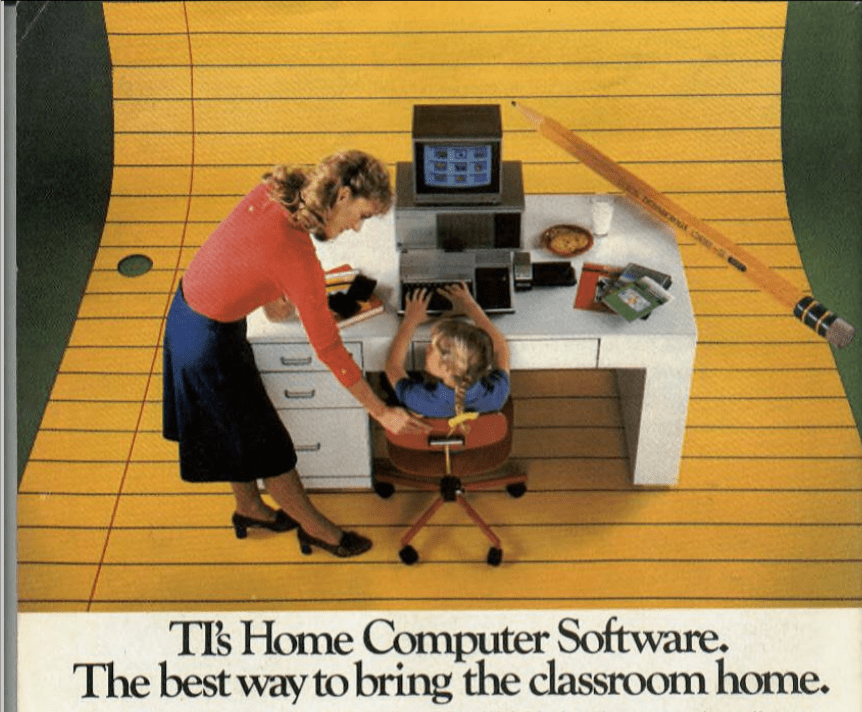
In 1979, Atari and Texas Instruments (TI) established a new category of computer, which hybridized the features of the personal computer and video game console. Like a video game system, they had dedicated graphics and sound chips and cartridge-based software, but they were also programmable and expandable, with peripherals like tape cassette drives and printers. But neither of their computers hit the “everyman” price point that would clearly put them in a new market segment—the Atari 400, at $550, cost nearly as much as two well-established personal computers (the TRS-80 and Commodore PET), and the TI-99/4 had a budget look but a premium price: at $1150, it was in the same ballpark as the Apple II.
Texas Instruments didn’t give up, and soon found ways to cut the cost of their computer. In the spring of 1981, they released a revised version, the TI-99/4A, with an improved keyboard, no built-in monitor, a new peripheral system, and a retail price of $525. But they soon lost the initiative as a slew of new entrants came into the market with ever-less-expensive offerings. This new category of video-game-adjacent personal computers became known as “home computers,” because of the ease with which ordinary householders could afford them. To compete in this category meant operating at scale: it took a lot of capital to set up a production line for custom sound and graphics chips, and the cost had to be amortized over many unit sales. Likewise, the most popular personal computer games on disk or tape in the early 1980s sold 20,000-30,000 copies, but that was the bare minimum required to make a ROM software cartridge economically viable.[1]
The ensuing competition led to a brutal price war in the home computer business that left few standing and none unscathed. In the process, the computer became an object, for the first time, of mass consumption. The first-generation personal computers were strictly of interest to hobbyists, while the second-generation that launched in 1977 found a wider hobby audience, but also sold to some companies, well-to-do households, and businessmen, who went out of their way to find a computer at a specialty retailer. Home computers, however, became the gadget of choice for middle-class households at Christmas season, available for purchase at department stores, right alongside televisions and Toast-R-Ovens. But what exactly were they buying—a passport to their childrens’ citizenship in the digital future, or just another game machine?
Following the Trend: The Color Computer
The first successor to the Texas Instruments 99/4 and the Atari 400 arrived in September 1980, with Radio Shack’s TRS-80 Color Computer, whose design followed the same hybrid playbook as its predecessors. Though it was branded as a successor to the TRS-80, it had completely different organizational and technological origins.
Oddly enough, the creation of the Color Computer (affectionately known as CoCo) began with a 1978 federal grant, for a computer system to disseminate information to Kentucky tobacco farmers. The Department of Agriculture called it Project Green Thumb. Tandy submitted a joint proposal with Motorola to build the terminals for the Green Thumb system, on which farmers could call up relevant information from a database, such as guidelines on pesticide use. The proposed terminal had a twelve-button keypad, a Motorola-designed graphics chip for displaying text or images on a TV screen, and a modem for connecting to the central computer over a telephone line. The Tandy/Motorola bid succeeded, and the information system launched in March 1980, with hundreds of Tandy/Motorola terminals.[2]
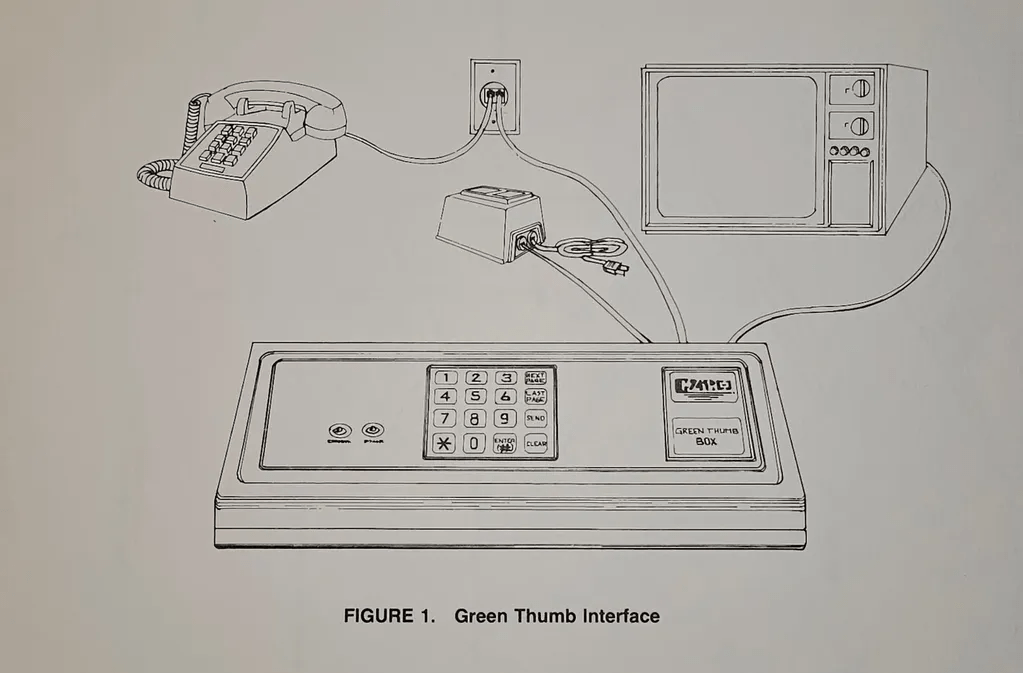
Tandy leadership was intrigued by the commercial possibilities of their terminal, and already had Green Thumb engineer Jerry Heep working on releasing it in Radio Shack stores as the TRS-80 VIDEOTEX. Videotex was one of the hot new buzzwords of the late 1970s, used to describe interactive systems that accessed (primarily textual) information retrieved from central computer systems via telephone, and then rendered it onto a television screen. Videotex systems could support a variety of information retrieval services (such as news, stock market prices, and weather forecasts), online shopping, and even games. With terminals that cost only a few hundred dollars and piggybacked on pre-existing, widespread technologies (the television and telephone), videotex looked like a shortcut to the future; Alvin Toffler’s Third Wave, post-industrial society of electronic cottages made real. Experimental and commercial videotex systems sprang up all over the world in the years around 1980, with the backing of computer makers, telecommunications giants, newspapers, television stations, and even national governments. It turned out, however, that few were interested in paying $399 for a terminal that could do nothing unless connected to expensive online information services, and Tandy quietly put the TRS-80 VIDEOTEX out to pasture.[3]
But Tandy had simultaneously launched a second offshoot of the Green Thumb terminal. The market share of the aging, monochrome TRS-80 was gradually slumping from its once-dominant position. John Roach, the executive who had backed the TRS-80 and who now served as Radio Shack’s executive vice president, saw the need for more appealing and engaging computer with color graphics and sound, to answer the threat presented by Atari and Texas Instruments. The Green Thumb platform, designed for a low price point and with color already built in, provided a great starting point. Tandy engineer Dale Chatham was put in charge of the design, though the chips all came from Motorola, and the core components were all shared with the TRS-80 VIDEOTEX: it used the same 6809E microprocessor (an enhanced version of the 6800) and MC6847 video chip, and the same low-quality chiclet keyboard. A port for ROM software cartridges replaced the VIDEOTEX’s modem, and several other ports were added for joysticks and other peripherals.[4]
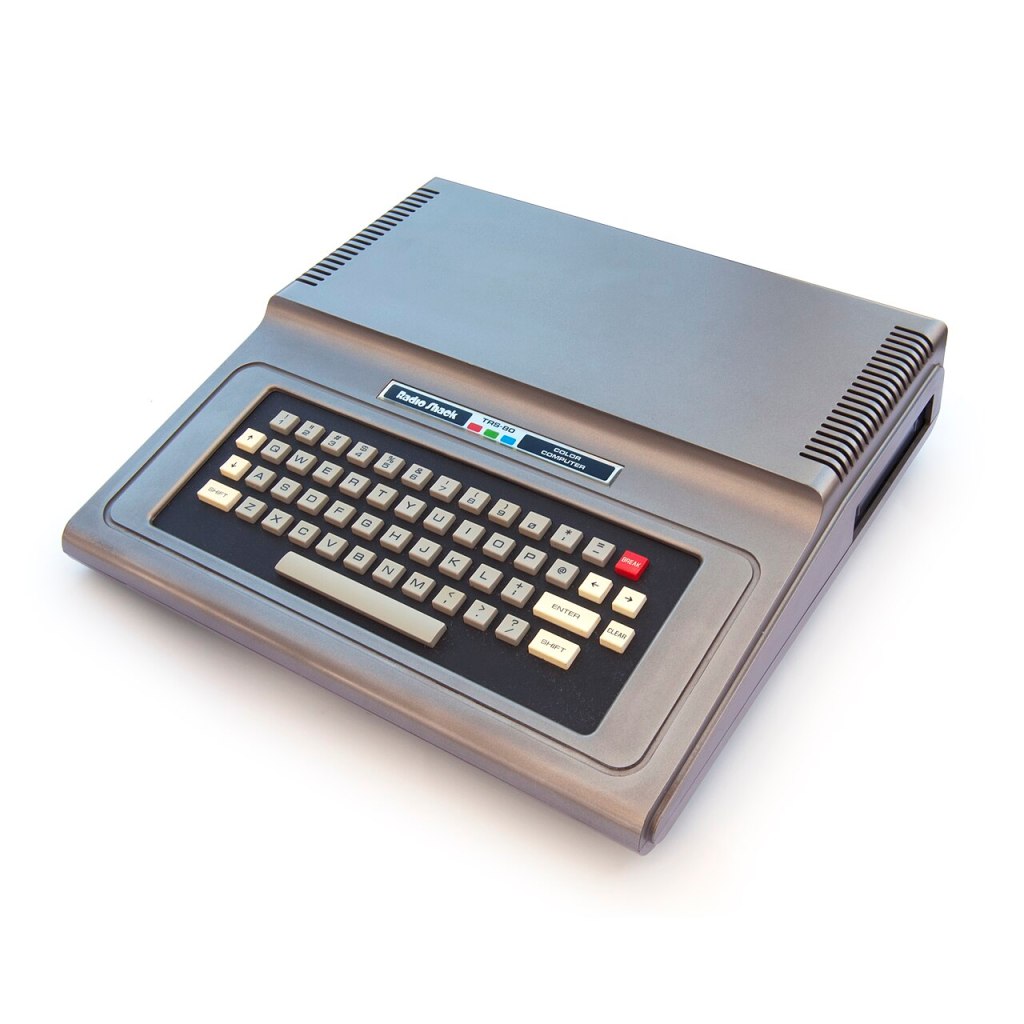
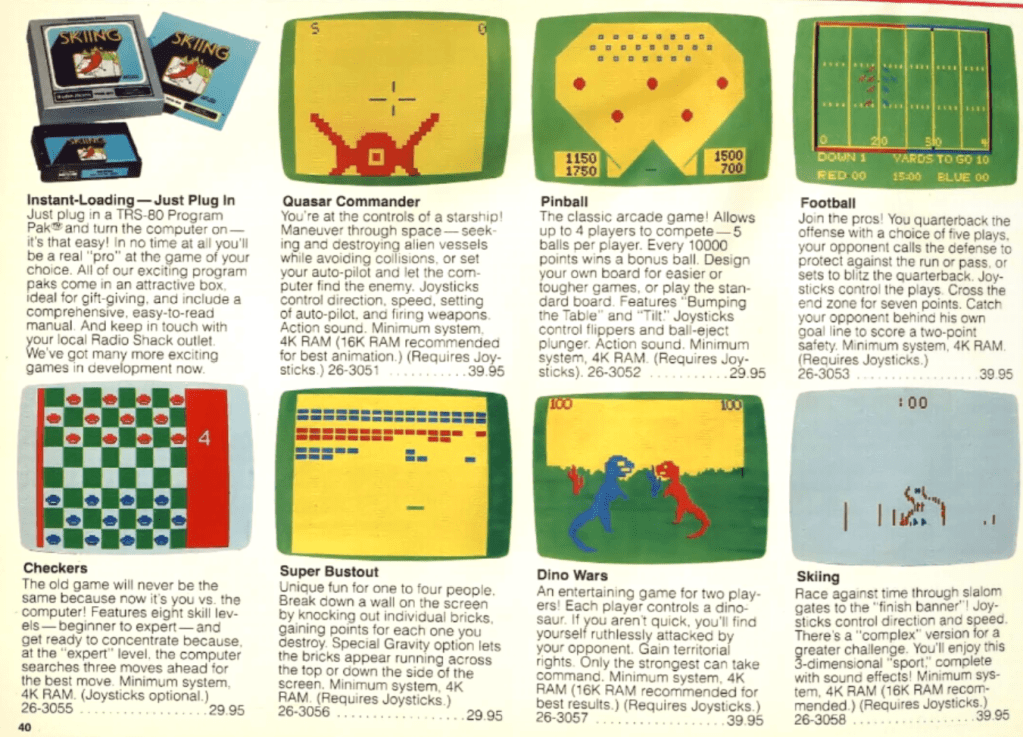
The Color Computer came in two versions, a $399 model with four kilobytes of RAM, and a $599 model with sixteen kilobytes and a more feature-rich BASIC interpreter. The price point was attractive enough, but this was not a computer to set the world on fire. The four-color graphics and single-channel sound paled in comparison to what TI and Atari offered, and the low-quality joysticks (they did not “self-center”) worked poorly for many arcade-style games. And then there was the dearth of software to consider. Radio Shack held to its strategy of forbidding third-party software from their stores unless they licensed it through Radio Shack, who took a substantial percentage (if they agreed to the license at all). This discouraged software developers from authoring Color Computer software, and at launch there were only a handful of Radio-Shack-authored titles available (mostly games, of course).[5]
The Coco was a decent-enough machine. But it was not the sort of computer to start a war.
Throwing the Gauntlet: The VIC-20
If Tandy was hoping to shore up a gradually weakening position, Commodore was looking to reinvent themselves for the American market. After a strong showing in 1978, U.S. sales of the Commodore PET flatlined while the overall market grew rapidly, leaving them a relatively minor player. In 1980 they sold about half as many computers as Tandy. Commodore’s marketing and documentation were poor, its software catalog middling, its retail and support network anemic. And, of course, the PET lacked color graphics or sound.[6]
Commodore’s strengths lay overseas, especially in Europe, where the PET held a dominant position in the UK and Germany. It’s fitting, then, that it was at a spring 1980 meeting in London that Commodore chief executive Jack Tramiel committed to an attack on the low-end computer market. Most of his engineers and executives disagreed with him (including Chuck Peddle, lead designer of the 6502 processor and the PET). They wanted to go after the business market with a high-end Apple-killer. But Tramiel had been rattled by the British Sinclair ZX80, a tiny home computer that went on sale in the U.K. in January 1980 for just £99.95, equivalent to less than $150. He also feared that the Japanese were about to pounce on the home computer business, just as they had done before in calculators, stereos, and television sets. He wanted to put out something in 1981 that would instantly upstage all of the competition, existing and potential.[7]
By coincidence, Commodore soon had something to hand that fit the bill. For years, MOS Technology (Commodore’s Pennsylvania-based semiconductor subsidiary) had a chip kicking around without a product to put it in: the video interface chip (or VIC), which could display full-color graphics and generate three-channel sound. Al Charpentier had designed it in 1976 and 1977 with the hopes of selling it to Atari for a successor video game console to the Atari VCS, but Atari (at work on the 400 and 800 instead) declined the offer. Bob Yannes, an electronic music enthusiast who joined MOS right out of Villanova University in the summer of 1979, was fascinated by the VIC graphics chip. In May 1980, frustrated by the repeated failure to find a buyer for it, he decided to prove himself that it could be the basis for a low-cost, high-quality computer that would easily outdo the Sinclair ZX80 that was causing so much buzz. Yannes put together a prototype in his bedroom, and when Tramiel saw it on a visit to MOS, he knew he had found his Sinclair-killer. He bypassed Peddle’s computer design group and ordered that Yannes’ design be ready for demonstration at the June Computer Electronics Show.[8]
The computer built from that prototype, the Commodore VIC-20, became available in the U.S. and Europe in the spring of 1981. (The origin of the “20” in the name is disputed, perhaps it was based on the twenty-two columns in the display, perhaps it was simply chosen to “sound friendly.”) It is not surprising that Peddle and the others within Commodore who wanted to build computers for serious computer users had a hard time accepting the VIC. Though it had the same MOS 6502 processor as the PET, it could render only twenty-two columns of text (at a time when serious users were upgrading from forty to eighty), and contained only five kilobytes of RAM—sufficient for 1975 but a pittance by 1981. For external storage Commodore focused on software support for the Datassette tape drive, when serious users had already moved to disk drives. This was, to men like Peddle, a toy, not a real computer, and that assessment wasn’t unfair. The selling points were the vibrant graphics and sound from the VIC chip (which supported eight colors and three voices), the cartridge port that made playing games as easy as possible, and the extremely low price: just $299, besting the TRS-80 Color Computer by $100.[9]
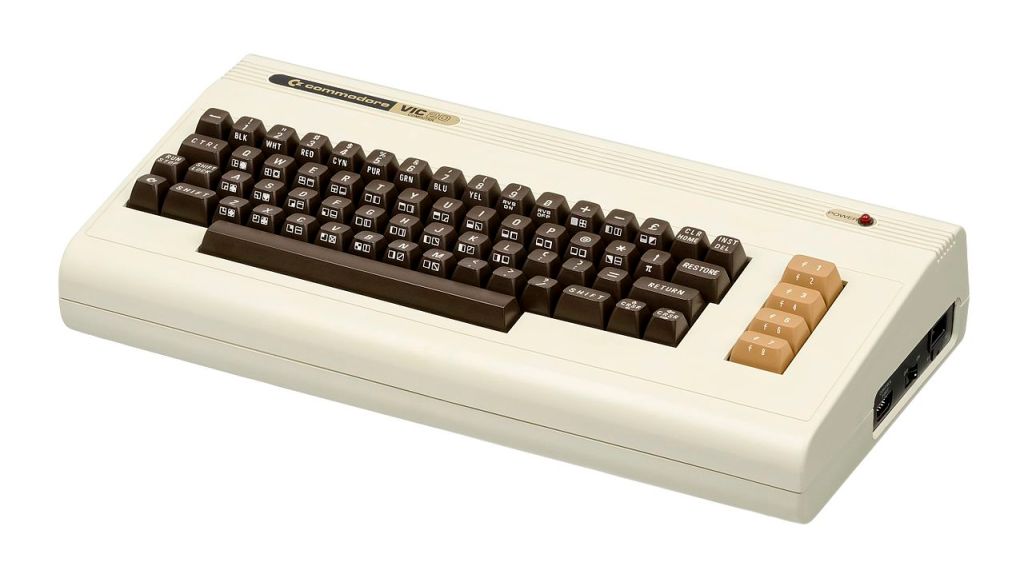
It didn’t hurt that the VIC-20 sported a real, full-sized keyboard, unlike the membrane or chiclet keyboards on most other home computers: in fact, it was nearly all keyboard, with a compact case that fit the motherboard under the keys. But for the critics this was all part of the problem: why offer a low-cost home computer with an expensive keyboard cutting into already-slim margins, when they could be selling computers for over one thousand dollars with comfortable profit margins? Those writing business software for the PET line teased their home computer counterparts that the VIC-20 “would be given away for free with every ‘real’ computer sold.”[10]
Tramiel saw things differently in light of Commodore’s history and capabilities. Commodore had endured, and nearly been destroyed by, the calculator wars in the 1970s, and Tramiel learned that the key to victory in low margins electronics was cost control and vertical integration. Commodore had a huge advantage in that regard: owning its own semiconductor supplier, MOS Technology, it could acquire its chips at cost while competitors paid wholesale (Atari was even buying the processors for its home computers from Commodore!) Texas Instruments had its own semiconductor plants too, and so might have been as dangerous a threat as it was during the calculator wars, but the TI-99/4 was saddled with a much more expensive sixteen-bit processor with no other buyers to drive higher volumes (and so lower unit costs).[11]
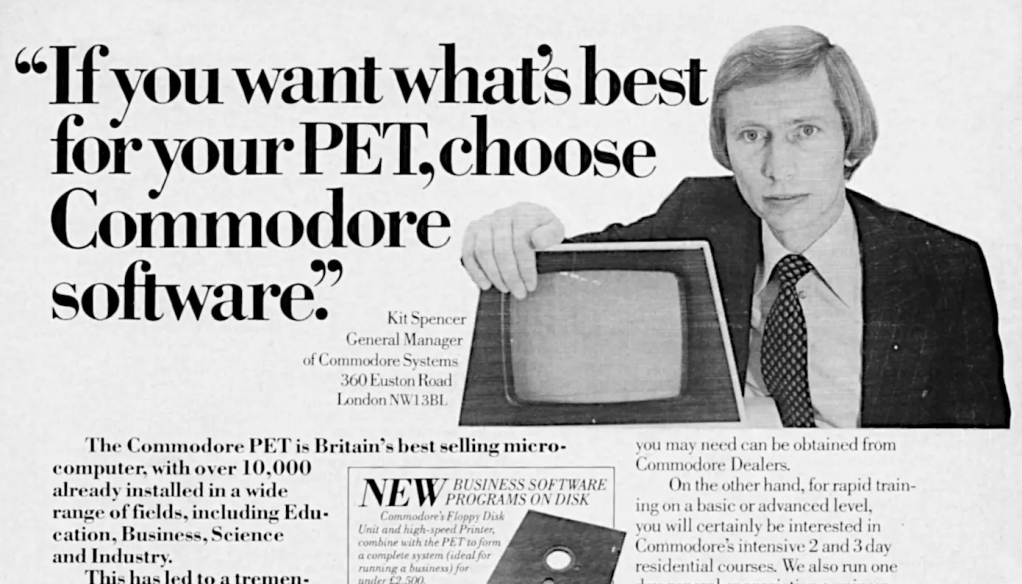
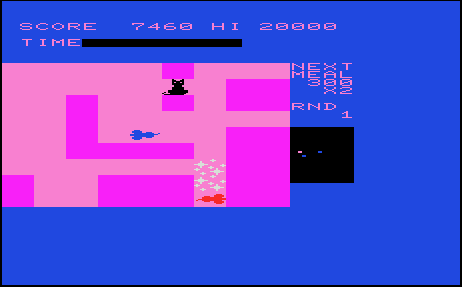
Tramiel drew on Commodore’s international resources to propel the VIC to success. An early release in Japan (as the VIC-1001) in the fall of 1980 helped build a catalog of barely-disguised arcade clones from Japanese developer HAL Laboratory: Space Invaders became VIC Avenger, Night Driver became Road Race, Pac-Man became Jelly Monsters in the UK, but a less brazen copy called Cosmic Cruncher in the US, where Atari would be paying more attention. Kit Spencer, the British executive who masterminded Commodore’s dominance in the UK, came to the US to oversee the marketing of the VIC. An American software team under Michael Tomczyk (who later documented the rise of the VIC-20 in his book Home Computer Wars), spit out low-quality VIC-20 games on cassette, mostly PET ports, bundled in six-packs. Commodore also licensed popular personal computer games, like the Sargon II chess simulator and Scott Adams adventure series, which Andy Finkel, their best game programmer, adapted to VIC ROM chips.[12]
In his quest to conquer the mass market, Tramiel burned his bridges in high-end retail. Figuring that dedicated computer stores like ComputerLand were more motivated to sell expensive business computers than his new cheap models, he convinced mass market retailers that VIC-20s were simple enough to sell in their stores. By the 1981 holiday season, shoppers could by a VIC-20 at K-Mart, a national discount department store chain. Others followed in 1982, including Toys “R” Us, Sears, and Target. Commodore offered big retailers a discount on wholesale prices, and as the retail price of the VIC-20 plummeted, computer dealers complained “that they could buy VICs cheaper at K-Mart than from Commodore.”[13]
The War
The home computer war began in earnest in 1982. At the beginning of that year, the VIC-20 had a retail price of $300, the Atari 400 and TRS-80 Color Computer each cost $400, the TI-99/4A went for $450.[14]
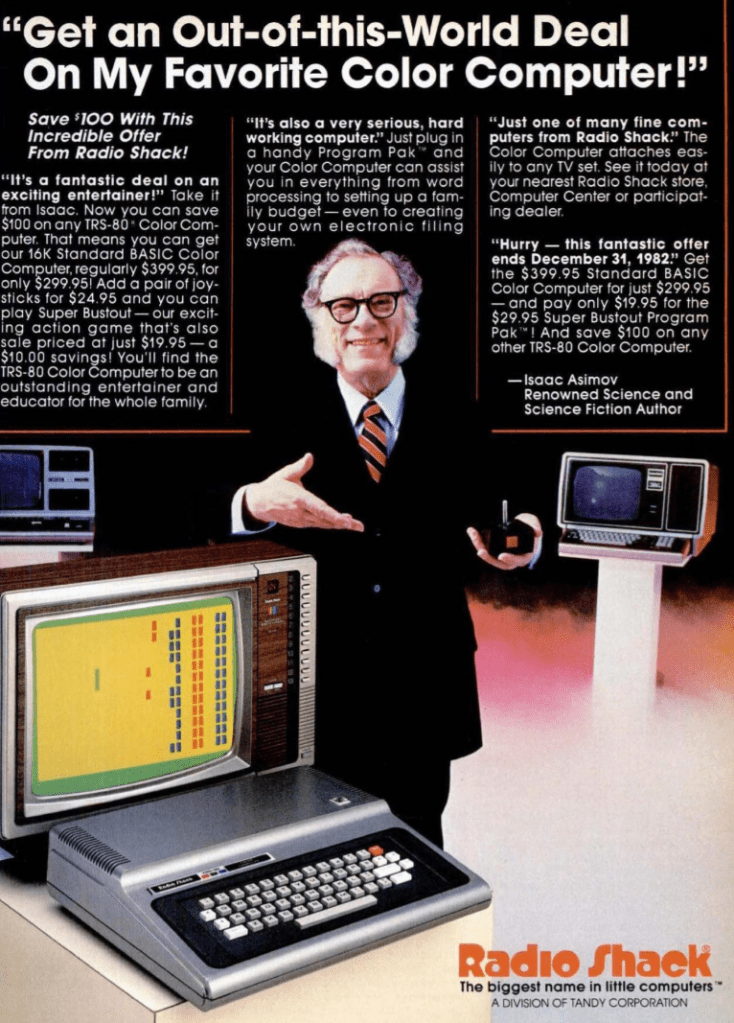
At first, it was a marketing war. In order to convince the everyman and everywoman that the computer was an approachable and easy-to-use appliance, not the forbidding monstrosity of popular imagination, each brand enlisted a well-known spokesman to put a friendly face to their product. They appeared in full-page color magazines ads and in national television spots. Both Tandy and Commodore went for the sci-fi angle, to emphasize the forward-looking nature of their product (and, presumably, its users). Prolific author Isaac Asimov, a TRS-80 user, became the pitchman for the Color Computer, while Kit Spencer recruited Star Trek actor William Shatner for the VIC-20 (Leonard Nimoy was already taken by Magnavox). Commodore certainly came out ahead: Asimov’s horn-rim glasses and mutton-chop sideburns made him look more like a relic of the past than a herald of the future, while Shatner was about to rocket to a new stratum of fame as star of a summer 1982 blockbuster, Wrath of Khan.[15]
Texas Instruments and Atari, on the other hand, chose warm-hearted TV personalities to highlight the friendliness of their computers. TI hired Bill Cosby, a comedian and actor who hosted the Saturday-morning cartoon Fat Albert and the Cosby Kids. Atari got into the game late, in the summer of 1983, when they borrowed the kindly image of Alan Alda, recently retired from his role as the wisecracking army surgeon “Hawkeye” on M*A*S*H.[16]
Then, it became a price war. The triggering event for this new phase was likely the arrival of the Timex Sinclair 1000 in July. Adapted from the British Sinclair ZX81 (successor to the ZX80 that had spooked Tramiel), it sold for just $99.95. Though it had only black-and-white graphics and a measly two kilobytes of RAM, it was a fully-functional computer with a Z80 microprocessor at an unheard-of price. In August, Texas Instruments responded with a $100 rebate for the 99/4A, while Commodore slashed the wholesale price on the VIC by $40, and in December Atari offered a $55 rebate on their 400. Along with other price decreases, these cuts brought the retail price of all of these computers to $200 or less.[17]
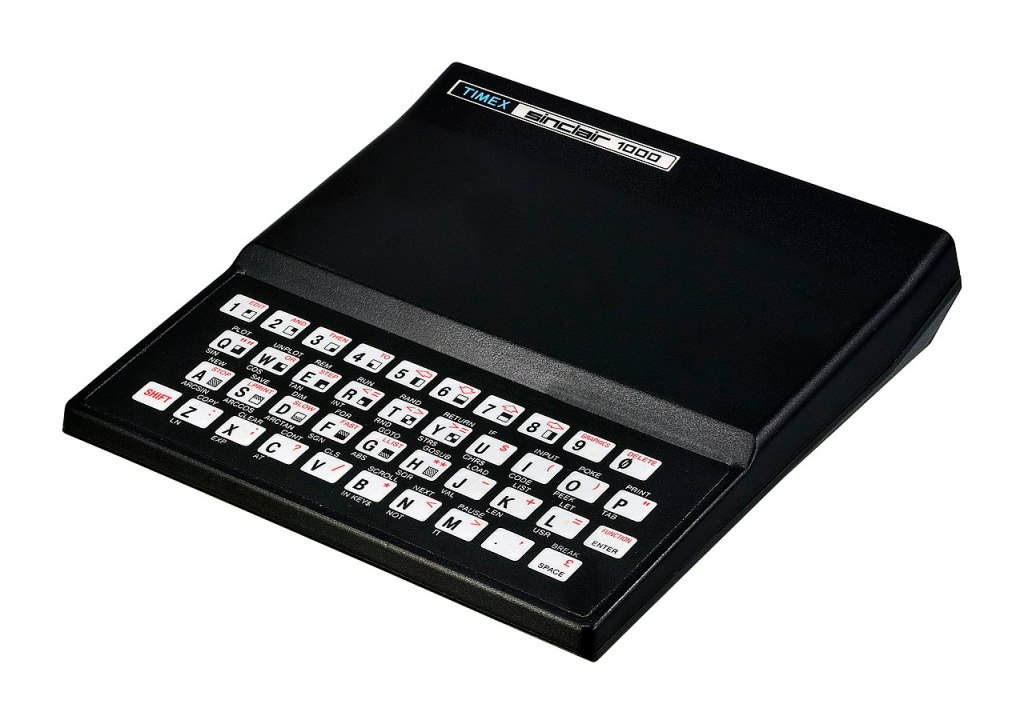
In January 1983, Commodore cut the VIC-20 wholesale price to $130, and some big retailers began selling it below wholesale as part of a bundle, making up a bit of profit on the sale of a modem, cassette player, or software package. By April they were selling VIC-20s for less than $100, and Texas Instruments, increasingly desperate, announced that they would also slash their price to $100 in June. Meanwhile Timex slashed the price of the Sinclair to an absurd $50. By this point, with millions of units sold, the home computer market was heavily saturated, and making sales became more difficult, even as the profit per unit became slimmer, or even negative.[18]
In June Commodore tightened the screws to the limit, by slashing the price of all of their home computer software in half. They had also been steadily driving down the price of their VIC-20 successor, the Commodore 64, released in the second half of 1982. The Commodore 64 was an incredible computer, in the etymological sense of the word. Though still using a variant of the venerable 6502 processor, the same peripheral interfaces as the VIC-20, and a similar case, it was in every other way superior, with its eponymous sixty-four kilobytes of memory, forty-column text output, a music synthesizer (designed by Bob Yannes), and sixteen-color graphics with native support for “sprites” (animated, movable images usually representing the player avatar, enemies, or projectiles). By mid-1983, even the Commodore 64 was selling for as little as $200, the same amount the far-inferior VIC-20 had sold for less than a year ago.[19]
The TI 99-4/A was in its basic technical capabilities superior to the VIC-20, with nearly four times the memory and a more powerful processor. At the end of 1982, Texas Instruments was producing 120,000 computers per month and outselling all its rivals. But the TI’s more expensive components made it impossible to keep up with Commodore’s relentless price slashing: the VIC-20 cost only seventy dollars to make, while the 99-4/A cost over one hundred. TI had no other virtues to compensate for a higher price: they had taken an aloof attitude towards hobbyists, guarded the secrets of their hardware, and never attracted a stable of third-party software writing talent. Their peripheral strategy was a mess, dependent on an expensive and under-supplied expansion box. So, Bill Turner, head of the TI consumer products division, followed Commodore over the precipice.[20]
In July, Texas Instruments reported a $120 million dollar loss for the second quarter. The future looked even bleaker: at the prices levels Commodore had driven them to, they would lose money on every additional 99/4A sold, and Commodore’s software price cuts left little room to make up profits elsewhere. Turner resigned. A few months later, TI announced a total withdrawal from the home computer market, and put all remaining inventory on clearance. Timex had begun the price war, but their black-and-white Sinclairs couldn’t compete with such cheap color computers, and, they surrendered also, in the spring of 1984.[21]
The war was over, and it was time to tot up the butcher’s bill.
The Survivors
In October 1983, the New York Times’ technology reporter epitomized the carnage: “[t]he home computer field thus resembles a battle in which all sides kill one another off and no one is left standing.” In truth, there were survivors, though none were left unscathed.[22]
Atari stayed in the fight and continued to release new eight-bit computer models, but ended up a loser on multiple fronts. The computer wars ate any potential profits from their computers, and for the sake of those computers Atari had disrupted their video game system pipeline: the Atari 400 and 800 had evolved from a project originally intended to become their next generation video game console. So, the next console they did release, the Atari 5200, was based on the 400 / 800 platform, and flopped hard. A generate retreat in video game sales battered Atari further and they took huge financial losses.[23]
Tandy never seriously tried to win the home computer wars, nor did they have a real opportunity to do so. Their retail distribution network defined both the floor and their ceiling of their sales. As long as the Radio Shack brand remained attractive enough to draw in tinkerers and electronics-lovers, they had a captive audience to sell computers to in their thousands of retail outlets, and could keep their prices slightly above the competition. But with no presence at huge retailers like Sears, K-Mart, and the like, they would never keep up with their competitors in sales volume either. They continued to release revised Color Computer models until 1990, when they shut down the line for good.[24]
Commodore, the putative victor, pulled in over $1 billion in sales in 1983, with profits of over $100 million. But even they bore scars. The rapidly falling prices in 1982 and 1983 cost them a lot of money from price protection agreements with large retailers, guaranteeing them compensation for inventory they had bought high and now had to sell low.[25]
More critically, by 1984, Commodore had lost its most important people, willingly or otherwise: Chuck Peddle went first, taking PET engineer Bill Seiler with him in October 1980 to start a new computer business, Sirius Systems (later Victor Technologies). A vengeful Tramiel burned Peddle professionally and personally with a suit over stock compensation that cost Peddle millions that he had hoped to use as both investment capital and nest egg. Kit Spencer, who devised the highly successful marketing campaign the VIC-20, was pushed out in 1983 by a new company president brought in by Commodore’s long-time eminence grise, financier Irving Gould. Most of the key engineers on the Commodore 64 team, including Bob Yannes and Al Charpentier, left that same year; they intended to make computers, too, but after a lawsuit by Commodore they pivoted to music synthesizers.[26]
Finally, in early 1984, Jack Tramiel himself was pushed out, after a blow-up with Gould at the Consumer Electronics Show. The reasons are disputed: perhaps Gould was angry about the losses from price protection, perhaps he was unhappy about Tramiel placing his own sons in key leadership positions, perhaps yet another new president had demanded Tramiel’s departure as the price of accepting the job. Whatever the reasons, Tramiel was not out of the game long. Bushnell sold Atari to Warner Communications in 1976 to acquire the capital to fuel its rise; now, as a distressed Atari descended, Tramiel bought up the home computer and game console division and brought his sons with him to challenge his former employer. Commodore would coast for some time on the brilliance of the Commodore 64, but, for it, like Atari, the best days were already in the past.[27]
Just a Video Game?
But surely, if anyone was a winner of the home computer wars, it was the middle-class consumer? The relentless price-cutting by sellers allowed millions of buyers to bring computers into their homes in the mid-1980s. In the 1982 Christmas season alone, Americans bought over one million home computers, and over two million the following Christmas. At the end of 1980, there were fewer than one million personal computers in the United States; by the end of 1983, there were over ten million.[28]
Home computer makers pitched their product as a high-brow, educational alternative to addictive, low-brow video game systems. William Shatner asked parents, “Why buy just a video game,” when for just a few dollars more they could get the VIC-20, “the wonder computer of the 1980s?” With the VIC-20, he promised, the “whole family can learn computing at home.” An Atari ad showed the educational value of the computer in action, depicting a child learning French from his computer to speak to his grandparents. Many adults bought into this message; a New York Times reporter talked to one shopper in December 1983, determined to find the best computer to teach her eight-year-old daughter grammar and math.[29]
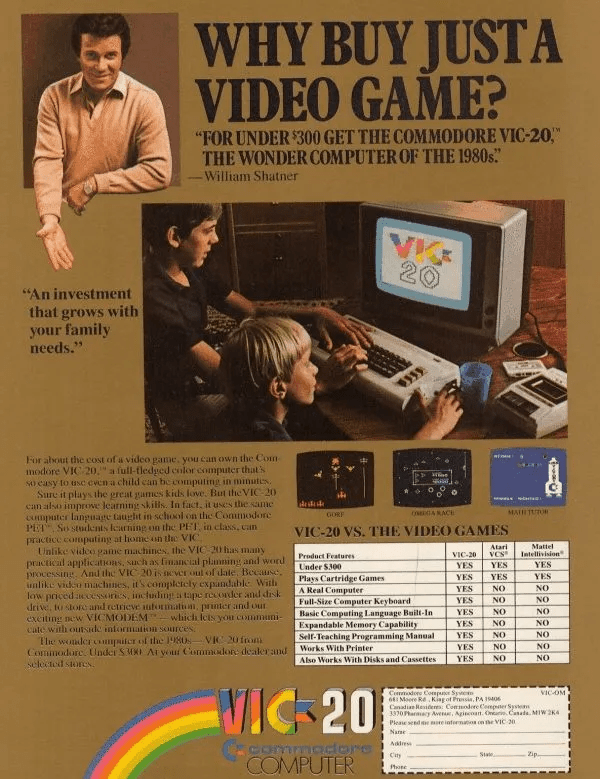
But a more seductive message was packed inside this aspirational one: “Learn a new language, or take your best shot at Missile Command,” touted Atari as if these were equally likely, and Shatner did not fail to mention that the VIC-20 “plays great games too” (though he didn’t wink, he may as well have). The VIC-20 ads took shots at video game consoles because those were its primary competition. “This was a kind of double coding,” as one academic paper put it, “acknowledging to children or playful adults that games were a central use of the computer, while also distancing the computer from games such that the purchasing decision could be justified.”[30]
In the vast majority of households, to the extent that they were used at all, were used to play games. These included some “educational games,” which ranged from simple flashcards and other drills to kid-friendly mystery games like Spinnaker Software’s Snooper Troopers, whose educational value was dubious. If any deep and serious learning occurred on home computers, it was among the small minority who used them to learned how to program (they were certainly a terrible way to learn a foreign language). Of all home computer programs sold in 1982, 57% were games, 22% educational (and many of those more game than not). Home computers were so successful as game machines that some forecaster believed that home computers would completely displace dedicated video game consoles.[31]
But maybe home computer buyers were chasing a misguided means to a legitimate end: if the truly educational computer were to be found anywhere, wouldn’t it be in the schools?
[1] “Atari Speaks Out,” Creative Computing (August 1979), 59.
[2] Boisy G. Pitre and Bill Loguidice, CoCo: The Colorful History of Tandy’s Underdog Computer (Boca Raton: CRC Press, 2014), 20-23.
[3] Pitre and Loguidice, CoCo, 24-25; Alvin Toffler, The Third Wave (New York: William Morrow, 1980).
[4] Pitre and Loguidice, CoCo, 29, 36-37.
[5] Pitre and Loguidice, CoCo, 33-34, 38-39, 43-44.
[6] Brian Bagnall, Commodore: A Company on the Edge (Variant Press, 2011), 330; Michael S. Tomczyk, The Home Computer Wars: An Insider’s Account of Commodore and Jack Tramiel (Greensboro: Compute! Publications, 1984), 22.
[7] Bagnall, Commodore, 230; Tomczyk, Home Computer Wars, 34, 44-45; Rodney Dale, The Sinclair Story (Gloucester: Duckworth, 1985), 95.
[8] Bagnall, Commodore, 71-74, 136, 195, 239-240, 243. Yes, the details in this paragraph are really spread over that many pages. This is one of the weaknesses of Bagnall’s book, which has barely any thematic organization.
[9] Tomczyk, Home Computer Wars, 126-128, 130, 134.
[10] Bagnall, Commodore, 231, 330.
[11] Tomczyk, Home Computer Wars, 123; Joseph Nocera, “Death of a Computer,” Texas Monthly (April 1984) (https://www.texasmonthly.com/news-politics/death-of-texas-instruments-home-computer).
[12] Bagnall, Commodore, 335, 339, 342, 344-348; Tomczyk, Home Computer Wars, 226-227.
[13] Bagnall, Commodore, 352-353; Tomczyk, Home Computer Wars, 235.
[14] Scott Mace, “Texas Instruments in the Saddle,” InfoWorld (May 30, 1983), 27; “NEECO”, COMPUTE! (February 1982), 34-35.
[15] Bagnall, Commodore, 360-361.
[16] Pitre and Loguidice, CoCo, 46; Deborah Wise, “World-famous Author Isaac Asimov Converts to Word Processing,” InfoWorld (January 11, 1982); Robert DeWitt, “Alan Alda,” Antic (August 1983).
[17] Pitre and Loguidice, CoCo, 70; Tomczyk, Home Computer Wars, 267-270.
[18] Tomczyk, Home Computer Wars, 267-270, Pitre and Loguidice, CoCo, 48.
[19] Tomczyk, Home Computer Wars, 237-238, 267-270.
[20] Tomczyk, Home Comptuer Wars, 258; Jerry Pournelle, “Computers for Humanity,” BYTE (July 1982), 396; David H. Ahl, “Texas Instruments,” Creative Computing (March 1984), 30; Bill Gaskill, “TI-99 Home Computer Timeline, part 3 of 4” (https://99er.net/hist3.html).
[21] Andrew Pollack, “Texas Instruments Lost $119.2 Million in Quarter,” New York Times (July 23, 1983); Bagnall, Commodore, 517; [“Timex clocks out of home-computer industry,” The Financial Post (March 3, 1984).
[22] Andrew Pollack, “Retreat Set By Texas Instruments,” New York Times, October 29, 1983
[23] Pitre and Loguidice, CoCo, 48, 76; Tomczyk, Home Computer Wars, 259; Goldberg and Vendel, Atari Inc., 566; Lendino, Breakout, 66.
[24] Pitre and Loguidice, CoCo, 48-50, 143, 169-170; Tomczyk, Home Computer Wars, 260.
[25] Andrew Pollack, “Founder of Commodore Resigns Unexpectedly, New York Times (January 14, 1984); Tomczyk, Home Computer Wars, 279-280.
[26] Bagnall, Commodore, 331, 464-465; Tomczyk, Home Computer Wars, 134; Tekla S. Perry and Paul Wallich, “Design Case History: The Commodore 64,” IEEE Spectrum (March 1985), 58.
[27] Tomczyk, Home Computer Wars, 284-285, 294; Bagnall, Commodore, 528-531.
[28] “Under the 1983 Christmas Tree, Expect the Home Computer,” New York Times (December 10, 1983); N.R. Kleinfeld, “Trading up in Computer Gifts,” New York Times (December 22, 1984); Martin Campbell-Kelly, From Airline Reservations to Sonic the Hedgehog: A History of the Software Industry (Cambridge: MIT Press, 2003), 238.
[29] “William Shatner Commodore VIC-20 Commercials,” The Retro Byte (April 6, 2021 [1982]) (https://www.youtube.com/watch?v=_JAU9Ntpoms); “Atari Home Computers 1981 Commercial Conversational French, Missile Command,” MYSATURDAYM0RNINGS (January 2, 2012 [1981]) (https://www.youtube.com/watch?v=SXZN9o7qlWU); Tomczyk, Home Computer Wars, 179; “Under the 1983 Christmas Tree, Expect the Home Computer,” New York Times (December 10, 1983).
[30] Bagnall, Commodore, 351; Leslie Haddon, “The Home Computer: Making of a Consumer Electronic,” Science as Culture 1, 2 (1988), 7-51; Jesper Juul and Laurel Carney, “Would You Like Games with that Computer? Revisiting Early Game History and Culture with the Commodore 64,” Proceedings of the DiGRA 2023 Conference, Seville, Spain (https://jesperjuul.net/text/gameswithc64). Even for those who did learn to program on a home computer, the capabilities that low-end models like the CoCo and VIC-20 offered to hobby programmers were inherently limited. ROM cartridge software allowed these computers to get by with a scant supply of memory and still run interesting software, because the data and instructions could be read directly from ROM at high speed. But ordinary users didn’t have the capability to burn ROM chips, and were stuck with just a few kilobytes to work with for their programs, compared to the sixteen kilobytes or more that commercial ROMs contained.
[31] International Resource Development, “Microcomputer Software Packages,” (September 1983), 161, 184; John Case, Digital Future: The Personal Computer Explosion—Why It’s Happening and What It Means (New York: William Morrow, 1985), 113-132; Creative Strategies International, Computer Home Software (1983), 47 (https://archive.org/details/1983ComputerHomeSoftware).

 Creatures of Thought
Great article, thanks for the nostagia!
Typo: reporterepitomized
LikeLike
Thanks, fixed.
LikeLike
Well… My parents decided we needed a computer in 1982 when I was in third grade… And they felt the market leader was the TI, so that is what we got!
That didn’t stick for long, although we typed in programs and had a blast with Tunnels of Doom!
LikeLike